PIF File Example: A Made-Up Face Cream, Part by Part
A PIF file example for cosmetics follows the five contents of Article 11(2) of Regulation (EC) No 1223/2009, which the EU and Great Britain texts share. They are a product description, the safety report, the manufacturing method with a GMP statement, proof of claimed effects, and animal-testing data. The worked example is a made-up face cream, Calm Day Cream, from a sample Eldris Check report.
Prices in this article are in pounds. Your quote is in US dollars.
Prices in this article are in pounds. Your quote is in euros.
How does the example map to Article 11(2)?
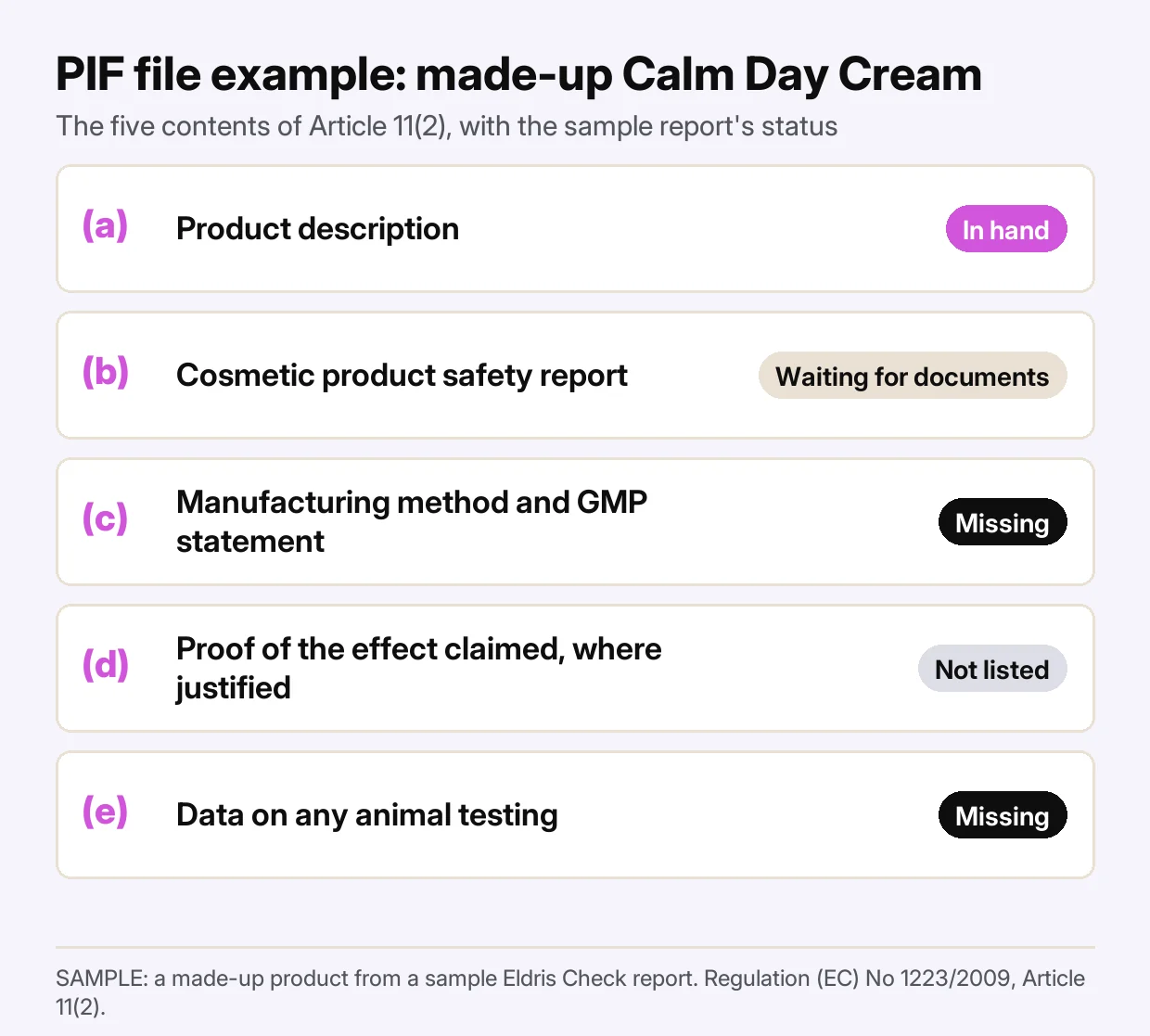
Each of the five items has a row below, with the example's status. Only item (a) was complete, item (d) was not listed, and the other three were waiting for documents.
Under Article 11(2), item (a) is a description that ties the file to one product: here, a face cream with one formula and one scented variation. Item (b) is the safety report, which Annex I splits into Part A, the safety information, and Part B, the assessment. Item (c) is a description of the method of manufacturing and a statement on good manufacturing practice under Article 8. Item (d) is proof of the effect claimed, where the nature or the effect of the product justifies it. The sample report does not list it, so the PIF file example leaves that row open. Item (e) is data on any animal testing by the manufacturer, its agents or its suppliers, including testing for countries outside the EU. The guide to what the CPSR and PIF contain covers the file in general.
| Article 11(2) | What it holds | In the Calm Day Cream example |
|---|---|---|
| (a) | Description of the product | Face cream, one formula, one variation (Rose) |
| (b) | Cosmetic product safety report | Waiting for the documents listed below |
| (c) | Manufacturing method and GMP statement | GMP certificate or statement missing |
| (d) | Proof of the effect claimed, where justified | Not listed in the sample report |
| (e) | Data on any animal testing | Statement on animal testing missing |
What does the PIF file example contain?
The example is one face cream with 13 ingredients, sent as 9 files, with one scented variation. The Eldris Check report found 12 of the 39 documents on its checklist in hand.
The product is made up, and every page of the sample report says so. Its formula sheet lists the 13 ingredients with percentages that add up to 100 %. One ingredient, phenoxyethanol at 0.90 %, is on the EU and Great Britain lists of allowed preservatives. Annex V, entry 29, sets its maximum at 1.0 %, and the report quotes that rule in its notes. Five fragrance documents were in hand: the perfume's name, code and supplier, the allergen declaration, the fragrance level and the IFRA certificate. The fragrance's own safety data sheet and certificate of analysis were missing. The variation, Rose, differs only in scent, so it sits inside the same Eldris Check report. Only what differs is checked again, and it still needed 3 things. The guide to formulas and variations covers when a variation needs its own CPSR.
PIF template: the list to copy
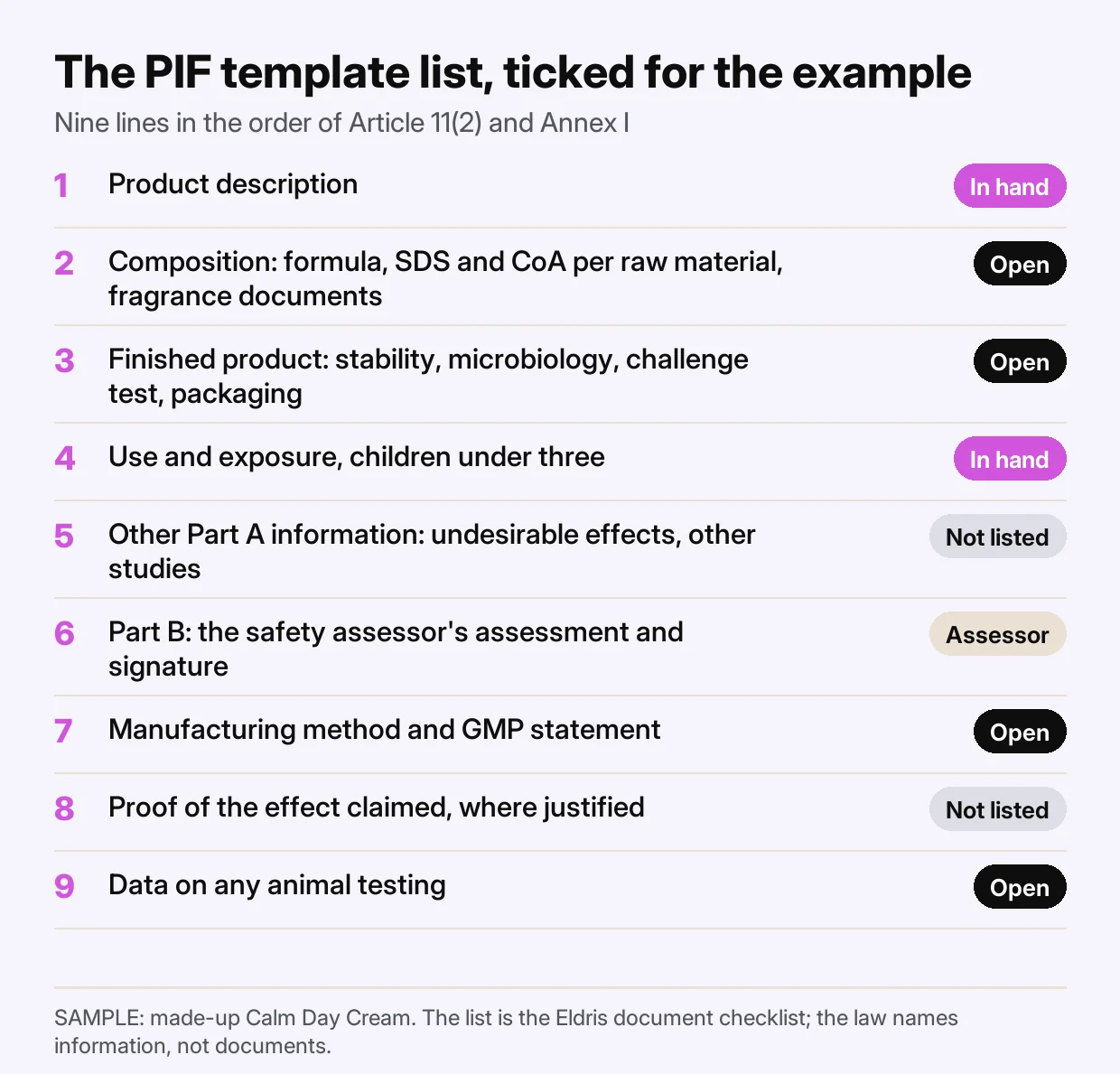
Copy the list below and tick each line as the document arrives. It is the Eldris document checklist, ordered by Article 11(2) and the Annex I headings.
For a PIF template, the law names information, not documents, so the documents in each template line are the ones Eldris asks for. The safety data sheet and certificate of analysis for each raw material and the IFRA certificate are Eldris start-list rules. Under Article 10(2) of the EU text, Part B is written by a person with a university qualification. The fields are pharmacy, toxicology, medicine or a similar discipline, or an equivalent course. Everything else comes from the brand, its suppliers and its manufacturer. Eldris does not carry out, arrange or recommend laboratory tests, so test results reach the file through the brand. In the example, lines 1 and 4 were in hand and lines 2, 3, 7 and 9 were open. Line 6 waits for the assessor, and the sample report does not list lines 5 and 8.
- Product description: name, product type, and every variation by shade or scent.
- Composition: the formula with percentages; a safety data sheet and a certificate of analysis for each raw material; the perfume's name, code and supplier, the allergen declaration and the IFRA certificate where there is fragrance.
- Finished product: stability data, the microbiological specification, challenge test results, and the packaging material's specification.
- Use and exposure: how and where the product is applied, and whether it is meant for children under three.
- Other Part A information: data on undesirable effects, and other relevant information such as studies on human volunteers.
- Part B: the safety assessor's conclusion, warnings and instructions of use, reasoning, name and address, proof of qualification, date and signature.
- Manufacturing: a description of the method and a GMP statement, or an ISO 22716 certificate where the manufacturer holds one.
- Where justified by the nature or the effect of the product, proof of the effect claimed.
- Animal testing: data on any test by the manufacturer, its agents or its suppliers. A statement that none was done is the usual form.
Which parts were still missing in the example?
27 documents: 21 from raw-material suppliers and 6 about the finished product. The report turned them into 4 requests to send.
Safety data sheets were in hand for 3 of the 13 ingredients, and certificates of analysis for 2. The supplier requests asked for a safety data sheet for 10 ingredients and a certificate of analysis for 11, the fragrance included. One request went to the raw-material suppliers in general, one to the fragrance supplier and one to a single-ingredient supplier, each as a message ready to copy. The fourth request went to the manufacturer. It asked for a stability test report, a challenge test report and a microbiological test of the finished product. It also asked for the packaging material specification, a GMP certificate or statement under ISO 22716, and a statement on animal testing. Two points, nanomaterials and CMR substances, were questions only the brand could answer. The supplier documents were marked as needed before an assessor can start.
Where is a PIF kept, and in which language?
In the EU, at the address on the label, in a language the authority understands. In Great Britain, at the address notified under Article 13, in English. Both texts keep it for ten years after the last batch is placed on the market.
In the EU, Article 11(3) of the Regulation asks the Responsible Person to make the file readily accessible at the address on the label. It may be electronic or in another format, and it is for the competent authority of the Member State where the file is kept. Article 11(4) applies the same rules to products notified under the earlier Directive 76/768/EEC. Its information must be in a language that the authority can easily understand. In Great Britain, the GB text of Article 11 keeps the ten years after the last batch is placed on the market. GOV.UK guidance words it as 10 years after the last batch was made available. That guidance does not cover Northern Ireland and points to separate technical guidance for it, and this article does not cover Northern Ireland either.
Frequently asked questions
What does a complete PIF include?
It includes the five items of Article 11(2): a product description, the safety report, the manufacturing method with a GMP statement, proof of a claimed effect where justified, and data on any animal testing.
Is there a PIF template I can download?
The Regulation sets the contents, not a form. The list in this PIF file example follows Article 11(2) and Annex I, so it can be copied as a checklist.
Who keeps the PIF, the brand or the Responsible Person?
The Responsible Person keeps it, under Article 11(1), for ten years after the last batch is placed on the market. In Great Britain it must be in English.
Can the PIF be kept electronically?
Yes: in the EU, Article 11(3) allows electronic or other format. The file must be readily accessible to the competent authority at the address on the label.
Does the PIF need a translation for every EU country?
Not under Article 11(3): in the EU it must be in a language that the competent authority of the Member State where the file is kept can easily understand. In Great Britain it must be in English.
Sources
The documents this guide relies on, each linked where the source is published online.
- Regulation (EC) No 1223/2009, Articles 10 and 11 and Annex I, EUR-Lex
- Regulation (EC) No 1223/2009, Article 11 as it applies in Great Britain, legislation.gov.uk
- Making cosmetic products available to consumers in Great Britain, GOV.UK
From the Eldris channel
60-second answers
10 short videos from the Eldris YouTube channel, 26 to 52 seconds long, each answering one question sellers ask.
- Length 0:44Who Qualifies to Perform a Hair Clay Cosmetic Safety Assessment?
- Length 0:29Must Perfume Batch Numbers Appear on the Container or Packaging?
- Length 0:26Do Cosmetic Bottles and Boxes Need Different Label Information in the EU?
- Length 0:36Who Must Be the Responsible Person for Cosmetics Under EU Law?
- Length 0:31Could a Rabbit Skin-Irritation Test for Algerian Rules Affect a Favourable CPSR or EU Placing?
- Length 0:40When Do I Need Extra Evidence for My Soap’s Safety Assessment?
- Length 0:49What Documents Are Required for Cosmetic Compliance Under EU Law?
- Length 0:32What Must a Responsible Person Do Before Selling Cosmetics in the UK?
- Length 0:50Can You Use Alpaca Wool in Soap Under EU Cosmetics Law?
- Length 0:52Do I Need Separate Safety Assessments for Each Perfume Scent or Just One?
Cosmetics compliance by Eldris
CPSR and PIF from £195 per formula, 5–10 working days
Eldris prepares the Cosmetic Product Safety Report (CPSR) and the Product Information File (PIF) for each formula. A variation of an assessed formula (new shade or scent) is £39.95. When Eldris is your EU Responsible Person, Eldris also files the CPNP notification for £99 per CPSR.
Get your CPSR and PIFAlso needed before you sell
EU & UK Responsible Person
The legal representative that sellers based outside the EU must name on their products before selling there, under Regulation (EC) No 1223/2009 for cosmetics (and the General Product Safety Regulation, GPSR, for other products). The UK has its own product rules; Eldris covers the UK as an additional market. Certificate and label address issued in under a minute.
from £195 one-off, then from £19.95 a month
Appoint your Responsible PersonDomain