SDS, CoA or TDS: Which Supplier Document Does What for a CPSR
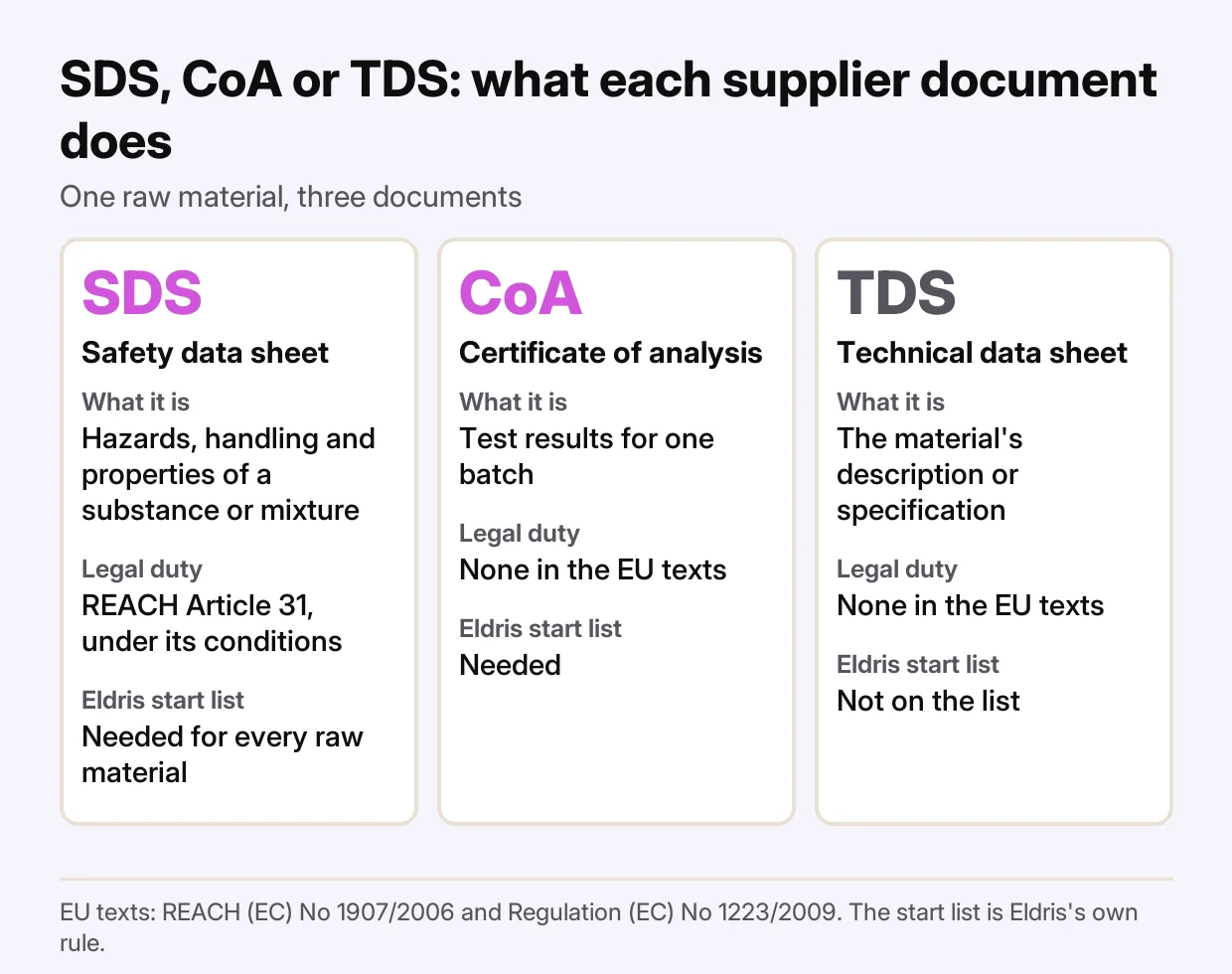
SDS, CoA or TDS: each supplier document answers a different question in a CPSR. A safety data sheet sets out a raw material's hazards and properties under REACH, a certificate of analysis gives one batch's test results, and a technical data sheet describes the material. The EU Cosmetics Regulation (EC) No 1223/2009 names none of the three, so asking for them is Eldris's own start-list rule.
Prices in this article are in pounds. Your quote is in US dollars.
Prices in this article are in pounds. Your quote is in euros.
What is a safety data sheet?
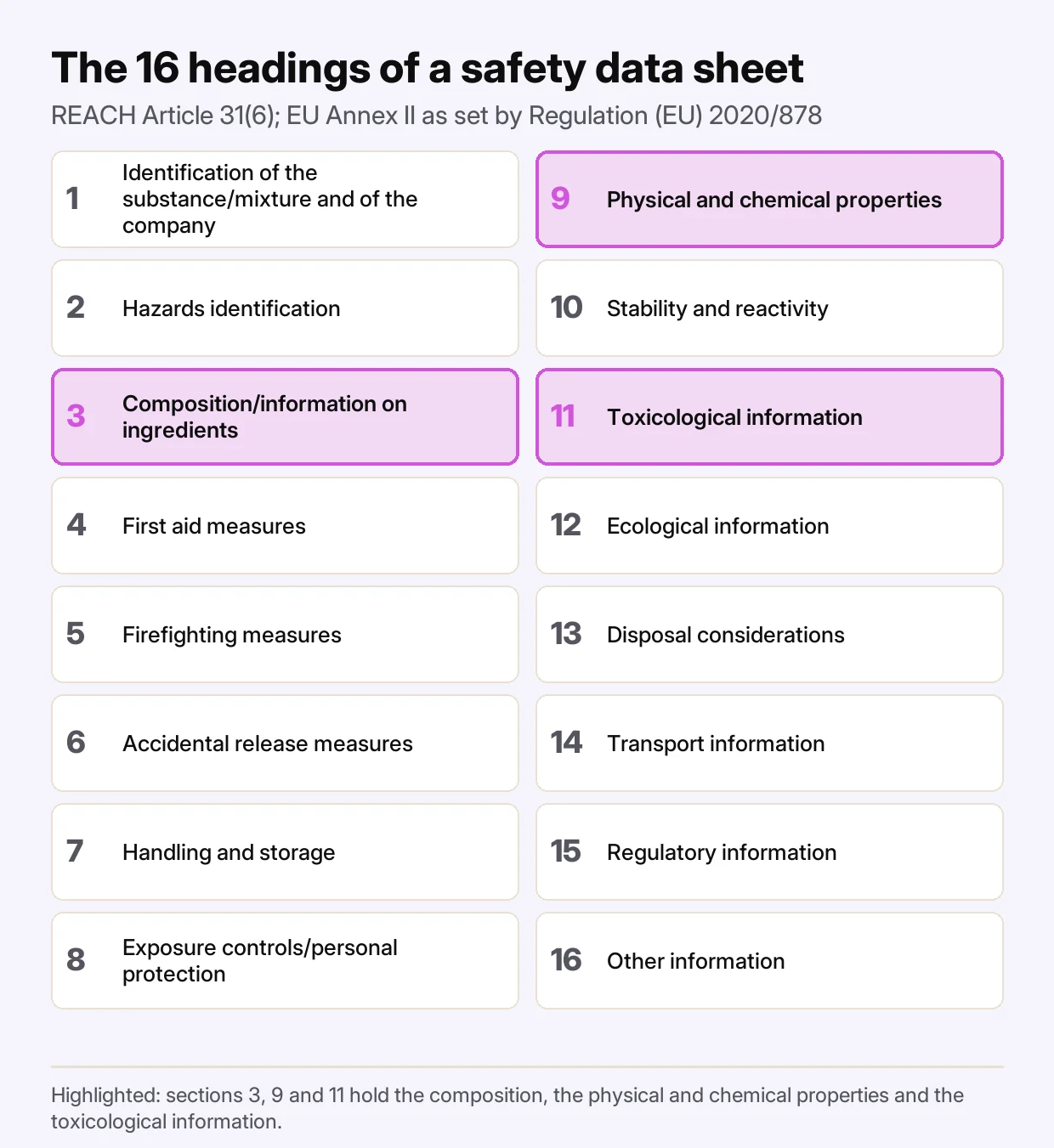
A safety data sheet is the document a supplier provides under Article 31 of REACH, in the EU text or the GB text. It has 16 headings, from identification and hazards to handling and toxicological information.
Under Article 31(1) of REACH, a supplier must provide a safety data sheet when a substance or mixture meets the criteria for classification as hazardous. The same applies to a substance that is persistent, bioaccumulative and toxic, or very persistent and very bioaccumulative. It also applies to a substance on the list set up under Article 59(1). For some unclassified mixtures, Article 31(3) makes the sheet available at the recipient's request. Article 31(6) sets the 16 headings and says the sheet is dated. Sections 3, 9 and 11 hold the composition, the physical and chemical properties and the toxicological information. In the EU, Annex II as replaced by Regulation (EU) 2020/878 sets their content, and applies from 1 January 2021. In Great Britain, the GB text of Article 31 asks for English, and its Annex II is still the 2015/830 version.
What is a certificate of analysis?
A certificate of analysis is the supplier's test result for one batch of a raw material. Neither the EU Cosmetics Regulation nor REACH uses or defines the term.
The Eldris checklist describes a certificate of analysis as covering the identity, purity, impurities and microbiology of the batch. It links the certificate to two Annex I points in the EU text. Part A, point 3 asks for the microbiological specifications of the substance or mixture and of the product. Point 4 asks for the purity of the substances and mixtures, and evidence that any trace of a prohibited substance is technically unavoidable. A safety data sheet gives the supplier's safety facts for one material. A certificate of analysis gives the test results for one batch, which is why Eldris asks for both. In 19 complete uploads from paid Eldris orders, 13 held at least one safety data sheet but only 6 held a certificate of analysis. Those came from 8 and 5 of the 13 projects behind the uploads, and the method and limits are in the dossier figures.
What is a technical data sheet, and why is it not enough?
A technical data sheet is a supplier's description or specification of a material. Neither the EU Cosmetics Regulation nor REACH uses the term, and the Eldris start list does not ask for one.
A text search of the consolidated EU Cosmetics Regulation of 18 May 2026 finds none of the three terms. The Regulation asks for information, not for named documents. Eldris asks for the safety data sheet and the certificate of analysis to cover that information. Its start list names exactly those two. Eldris counts a technical data sheet as neither a safety data sheet nor a certificate of analysis, so a TDS leaves both start-list lines open. The Eldris checklist has no line for one. A supplier that sends only a TDS has not answered a request for the other two. Name both documents in the request, with the material's trade name and INCI name. Eldris may still ask which ingredient an unmatched TDS belongs to. The guide to supplier sheets covers the fragrance side.
SDS, CoA or TDS: how do they compare?
The SDS covers hazards and handling, the CoA covers one batch's quality, and the TDS covers the material's description. Only the first two are on the Eldris start list.
Each document comes from the supplier of the material, and each answers a different line of the checklist. Whichever arrives first, SDS, CoA or TDS, only the SDS carries a legal duty, and only under the conditions of Article 31. For a fragranced product, the fragrance supplier also provides the IFRA certificate and the allergen declaration. The table sets the three side by side, with the Annex I point the Eldris checklist links each to. In the EU text, REACH Article 2(6) excludes finished cosmetic products intended for the final user from its supply-chain title. That title holds Article 31. It refers to cosmetics under Directive 76/768/EEC, and Article 38 of the Cosmetics Regulation reads such references as references to the Regulation. So REACH requires no sheet for the cream or perfume on sale.
| Safety data sheet (SDS) | Certificate of analysis (CoA) | Technical data sheet (TDS) | |
|---|---|---|---|
| What it is | Hazards, handling and properties of a substance or mixture | Test results for one batch | The material's description or specification |
| Legal duty | REACH Article 31, under its conditions (EU and GB texts) | None in the EU texts read | None in the EU texts read |
| What the checklist links it to | Annex I, Part A, point 8: toxicological profile | Annex I, Part A, points 3 and 4: microbiology and purity | Nothing: not counted as an SDS or a CoA |
| Eldris start list | Needed for every raw material | Needed | Not on the list |
Does every raw material legally need an SDS?
No. REACH ties the duty to the conditions in Article 31, and Article 32 covers substances for which a safety data sheet is not required. Eldris asks for an SDS for every raw material whatever its classification.
The rule that every raw material needs an SDS is Eldris's own, set on 29 October 2026, and it sits beside the certificates of analysis and the formula on the start list. A supplier may answer that its material needs no safety data sheet under REACH, and for a non-hazardous material that can be right. The start list still asks for the sheet, and the Eldris checklist ties it to the toxicological profile that Annex I asks for. The GMP statement comes from the manufacturer, not from an ingredient supplier. Eldris does not carry out, arrange or recommend laboratory tests, so any test result reaches the file through you, the brand. After you pay, upload what you have in your Eldris portal, and Eldris tells you what is still missing. The guide to documents needed to start has the full start list.
Frequently asked questions
How current must an SDS be?
Under REACH Article 31(9), the supplier updates it without delay when new hazard or risk-management information appears, or after an authorisation or a restriction. The dated revision goes to everyone it supplied in the previous 12 months.
Can a TDS replace a CoA?
Not on the Eldris start list: a technical data sheet describes the material in general. A certificate of analysis gives the test results for one batch, so Eldris asks for the certificate as well.
Which language must a safety data sheet be in?
In the EU, an official language of the Member State where the material is placed on the market, unless that state provides otherwise. In Great Britain, English.
Does the SDS have to be dated?
Yes. Article 31(6) of REACH says the safety data sheet shall be dated, and a revision under Article 31(9) carries its revision date.
Does Regulation 1223/2009 require an SDS?
It does not name one; in the EU text, Annex I asks for the composition of the product and the toxicological profile of each substance. The SDS and the certificate of analysis are the supplier documents Eldris asks for to cover that.
Sources
The documents this guide relies on, each linked where the source is published online.
- Regulation (EC) No 1907/2006 (REACH), Articles 2 and 31, EUR-Lex
- Commission Regulation (EU) 2020/878 amending Annex II to REACH, EUR-Lex
- Regulation (EC) No 1223/2009, Annex I, EUR-Lex
- REACH Article 31 as it applies in Great Britain, legislation.gov.uk
From the Eldris channel
60-second answers
10 short videos from the Eldris YouTube channel, 26 to 52 seconds long, each answering one question sellers ask.
- Length 0:44Who Qualifies to Perform a Hair Clay Cosmetic Safety Assessment?
- Length 0:29Must Perfume Batch Numbers Appear on the Container or Packaging?
- Length 0:26Do Cosmetic Bottles and Boxes Need Different Label Information in the EU?
- Length 0:36Who Must Be the Responsible Person for Cosmetics Under EU Law?
- Length 0:31Could a Rabbit Skin-Irritation Test for Algerian Rules Affect a Favourable CPSR or EU Placing?
- Length 0:40When Do I Need Extra Evidence for My Soap’s Safety Assessment?
- Length 0:32What Must a Responsible Person Do Before Selling Cosmetics in the UK?
- Length 0:50Can You Use Alpaca Wool in Soap Under EU Cosmetics Law?
- Length 0:52Do I Need Separate Safety Assessments for Each Perfume Scent or Just One?
- Length 0:43What Is a Cosmetic Product Information File (PIF) and Why Is It Needed?
Cosmetics compliance by Eldris
CPSR and PIF from £195 per formula, 5–10 working days
Eldris prepares the Cosmetic Product Safety Report (CPSR) and the Product Information File (PIF) for each formula. A variation of an assessed formula (new shade or scent) is £39.95. When Eldris is your EU Responsible Person, Eldris also files the CPNP notification for £99 per CPSR.
Get your CPSR and PIFAlso needed before you sell
EU & UK Responsible Person
The legal representative that sellers based outside the EU must name on their products before selling there, under Regulation (EC) No 1223/2009 for cosmetics (and the General Product Safety Regulation, GPSR, for other products). The UK has its own product rules; Eldris covers the UK as an additional market. Certificate and label address issued in under a minute.
from £195 one-off, then from £19.95 a month
Appoint your Responsible PersonDomain