Missing CPSR Documents: What 19 Customer Uploads Did Not Include
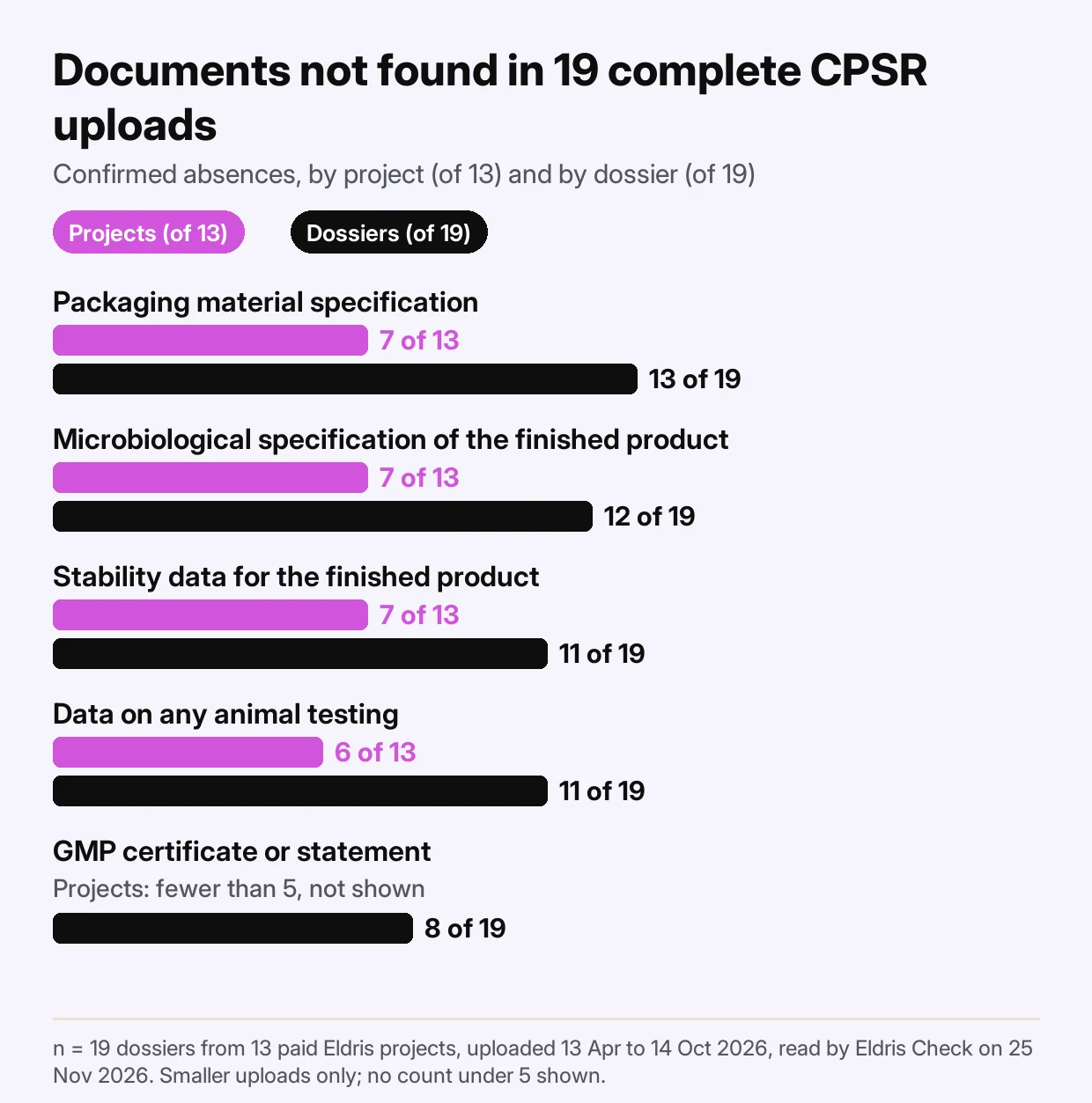
The missing CPSR documents in 19 complete uploads from paid Eldris orders were mostly about the product itself, not its ingredients. Eldris Check found no packaging specification in 13, no microbiological specification in 12, and no stability or animal-testing data in 11 each. In the EU, Regulation (EC) No 1223/2009 asks for all four in the safety report or its product file.
Prices in this article are in pounds. Your quote is in US dollars.
Prices in this article are in pounds. Your quote is in euros.
Which missing CPSR documents came up most often?
Four documents beyond the ingredient files led the count. Each was confirmed absent in at least 11 of the 19 dossiers, from at least 6 of the 13 projects.
In the 19 complete uploads, the documents most often not found were about the finished product and its file, not about raw materials. Annex I of the EU Regulation lists three of them in Part A of the safety report. They are stability under reasonably foreseeable storage, the microbiological quality of the product, and the purity and stability of the packaging material. The Product Information File then needs a GMP statement and data on any animal testing, under Article 11(2). The Great Britain text keeps the same letters. In Eldris Check's report, the manufacturer is the source named for all five documents. Formulas from one project share the same uploaded files, and one project contributed several dossiers to every count. Read the project column first. Eldris does not hold an order back for stability data or a GMP statement, which help but are not needed to start.
| Document | Where the EU text asks for it | Projects (of 13) | Dossiers (of 19) |
|---|---|---|---|
| Packaging material specification | Annex I, Part A, point 4 | 7 | 13 |
| Microbiological specification of the finished product | Annex I, Part A, point 3 | 7 | 12 |
| Stability data for the finished product | Annex I, Part A, point 2 | 7 | 11 |
| Data on any animal testing (usually a statement) | Article 11(2)(e) | 6 | 11 |
| GMP certificate or statement | Article 11(2)(c) | fewer than 5 | 8 |
Absence confirmed means the check accounted for every document in the dossier and found no such document. It does not mean the document never existed.
How many dossiers had a usable formula sheet?
7 of the 19 dossiers held a formula sheet with percentages that the check could read. In the other 12 it found none, and it could confirm that absence in fewer than 5 of them.
A formula sheet with percentages is the first item on the Eldris start list, together with a safety data sheet for every raw material and certificates of analysis. The Eldris checklist asks for every ingredient with its INCI name, its CAS number where it has one, its function and its percentage. In the EU, Annex I, Part A, point 1 asks for the qualitative and quantitative composition of the product. In the 12 uploads without a readable formula sheet, the check could not tell whether the product contained a fragrance. It therefore could not tell whether the fragrance documents applied either. Where the absence of a formula sheet was not confirmed, a scan or an unnamed document may have held it. The figure counts formula sheets found, not formula sheets missing, and a formula sheet with percentages is the first document worth sending.
What did the supplier documents cover?
13 of the 19 dossiers held at least one safety data sheet. Safety data sheets, certificates of analysis and technical data sheets together made up 36 of the 116 documents read.
In the 7 uploads where a formula sheet allowed the match, every one had at least one ingredient without a safety data sheet in the files. Nearly all of them also had at least one ingredient without a certificate of analysis. Eldris asks for both before the work starts, as the guide to supplier sheets explains. A technical data sheet is a different document, and the check counts it as neither a safety data sheet nor a certificate of analysis. Scans and photos made up 32 of the 116 documents, and nearly every dossier held at least one. A value on a scan counts only when two separate readings of it agree. No per-ingredient percentage is given here, because the tool counts every row of a formula, and water and listed fragrance constituents are rows too.
How this was measured
The figures on missing CPSR documents come from Eldris Check, an AI pre-check of a formula's documents, run on past customer dossiers. Only totals are published: no names, products or files, and no count below 5.
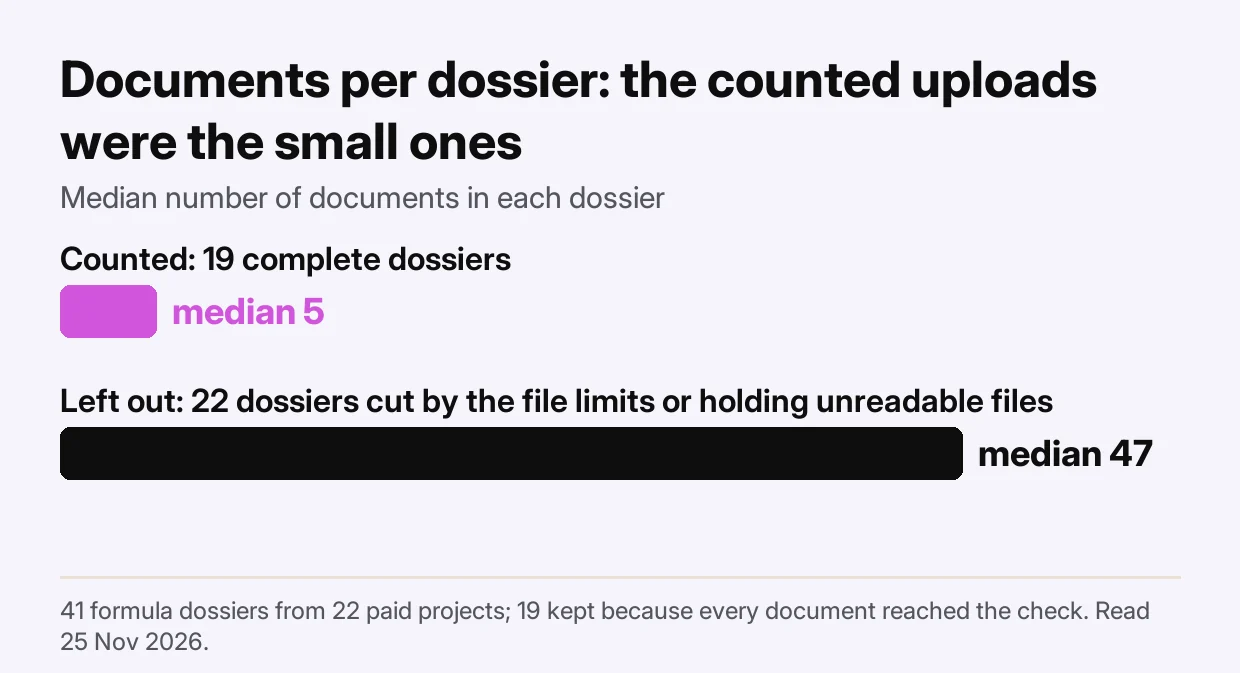
The source was the 41 formula dossiers of 22 paid cosmetics projects, as uploaded to their orders. Synthetic and test dossiers, and anything uploaded outside a paid order, were left out. Of the 41, 19 were kept, because every document in them reached the check. The other 22 were cut by the tool's limit of 25 files and 150 pages per formula, or held files it cannot open. The documents were uploaded between 13 April and 14 October 2026. They were read on 25 November 2026 against the EU rules and the Great Britain text of the Regulation. A document counts as missing only when the check confirmed its absence, which it does once every document in the dossier is accounted for. The checklist is Eldris's own, version 2026-11-25, and each line names the law or published rule behind it.
What the figures do not show
These are the smaller uploads. The 19 kept dossiers held a median of 5 documents, against 47 for the 22 left out. The figures describe small uploads, not every order.
Missing, in these figures, means not found in the documents uploaded to the order, whatever the brand held elsewhere. All but a few of the 19 formulas have a CPSR from the safety assessor in the order's files. The figures therefore describe what arrived with the upload, not what each final report rested on. The set is small, comes from one provider's paying customers in 2026, and leaves out 9 of the 22 projects entirely. No count below 5 is ever shown, so some lines are merged or left out. Too few dossiers showed a fragrance to break the fragrance documents down. Formulas that share the same files did not always get the same result. In Great Britain, GOV.UK guidance says a qualified safety assessor must check a product's safety before it is made available.
Frequently asked questions
Why are projects counted as well as dossiers?
A project is one order, and its formulas often share the same uploaded documents. Counting projects stops one large order from weighing several times.
What does could not confirm mean?
The check found no such document but could not rule out that an unread or unidentified file held it. Those cases are not counted as missing here.
Do larger uploads lack fewer documents?
This set cannot say. Dossiers over the tool's file and page limits were left out, so the figures describe smaller uploads only.
Which documents are needed beyond the quantitative formula, INCI, MSDS, GMP certificate and specs?
In the EU, Annex I also asks for stability data, the product's microbiological quality, challenge test results, and the packaging material's purity and stability. The PIF adds data on any animal testing under Article 11(2)(e).
Does missing mean my product cannot be sold?
Not by itself: missing CPSR documents here are ones not found in the files sent. The safety assessor asks for what the report needs, and all but a few formulas in this set have a CPSR on file.
Sources
The documents this guide relies on, each linked where the source is published online.
- Regulation (EC) No 1223/2009, Articles 10 and 11 and Annex I, EUR-Lex
- Making cosmetic products available to consumers in Great Britain, GOV.UK
From the Eldris channel
60-second answers
10 short videos from the Eldris YouTube channel, 26 to 52 seconds long, each answering one question sellers ask.
- Length 0:44Who Qualifies to Perform a Hair Clay Cosmetic Safety Assessment?
- Length 0:29Must Perfume Batch Numbers Appear on the Container or Packaging?
- Length 0:26Do Cosmetic Bottles and Boxes Need Different Label Information in the EU?
- Length 0:36Who Must Be the Responsible Person for Cosmetics Under EU Law?
- Length 0:31Could a Rabbit Skin-Irritation Test for Algerian Rules Affect a Favourable CPSR or EU Placing?
- Length 0:40When Do I Need Extra Evidence for My Soap’s Safety Assessment?
- Length 0:32What Must a Responsible Person Do Before Selling Cosmetics in the UK?
- Length 0:50Can You Use Alpaca Wool in Soap Under EU Cosmetics Law?
- Length 0:52Do I Need Separate Safety Assessments for Each Perfume Scent or Just One?
- Length 0:43What Is a Cosmetic Product Information File (PIF) and Why Is It Needed?
Cosmetics compliance by Eldris
CPSR and PIF from £195 per formula, 5–10 working days
Eldris prepares the Cosmetic Product Safety Report (CPSR) and the Product Information File (PIF) for each formula. A variation of an assessed formula (new shade or scent) is £39.95. When Eldris is your EU Responsible Person, Eldris also files the CPNP notification for £99 per CPSR.
Get your CPSR and PIFAlso needed before you sell
EU & UK Responsible Person
The legal representative that sellers based outside the EU must name on their products before selling there, under Regulation (EC) No 1223/2009 for cosmetics (and the General Product Safety Regulation, GPSR, for other products). The UK has its own product rules; Eldris covers the UK as an additional market. Certificate and label address issued in under a minute.
from £195 one-off, then from £19.95 a month
Appoint your Responsible PersonDomain