CPSR document check: find the missing documents before your safety assessment
Published Last updated
Eldris Check, a CPSR document check, reads a cosmetic formula's documents, looks up each readable ingredient, by CAS number and by exact name, in the EU cosmetics rules (Regulation (EC) No 1223/2009, Annexes II–VI) and the Great Britain rules (England, Scotland and Wales; Northern Ireland follows the EU rules), and reports what is missing, what to fix and what to ask each supplier for. It costs £9.95 per formula and £2.95 per variation. Each formula usually takes a few minutes.
Eldris Check is an AI pre-check of your documents, not a signed safety report. A CPSR (Cosmetic Product Safety Report) must be signed by a qualified safety assessor.
This describes Regulation (EC) No 1223/2009 as it applies in the EU, which sets what must be in place. Before a cosmetic product is placed on the market, the responsible person must ensure that it has undergone a safety assessment and that a cosmetic product safety report (CPSR) is set up (Article 10(1)), and must notify it to the European Commission, which is done through the CPNP (Article 13(1)). When it is placed on the market, the responsible person must keep a product information file (PIF) for it (Article 11(1)). Where any of these is missing, the competent authorities must require the responsible person to take all appropriate measures, including corrective action bringing the product into conformity, withdrawal of the product from the market or its recall (Article 25(1)). Great Britain applies its own retained version of the same Regulation: there, Articles 10 and 11 set the same duties, and Article 13 requires the notification to be submitted electronically to the Secretary of State instead of the European Commission.
Start your check
What the CPSR document check report shows
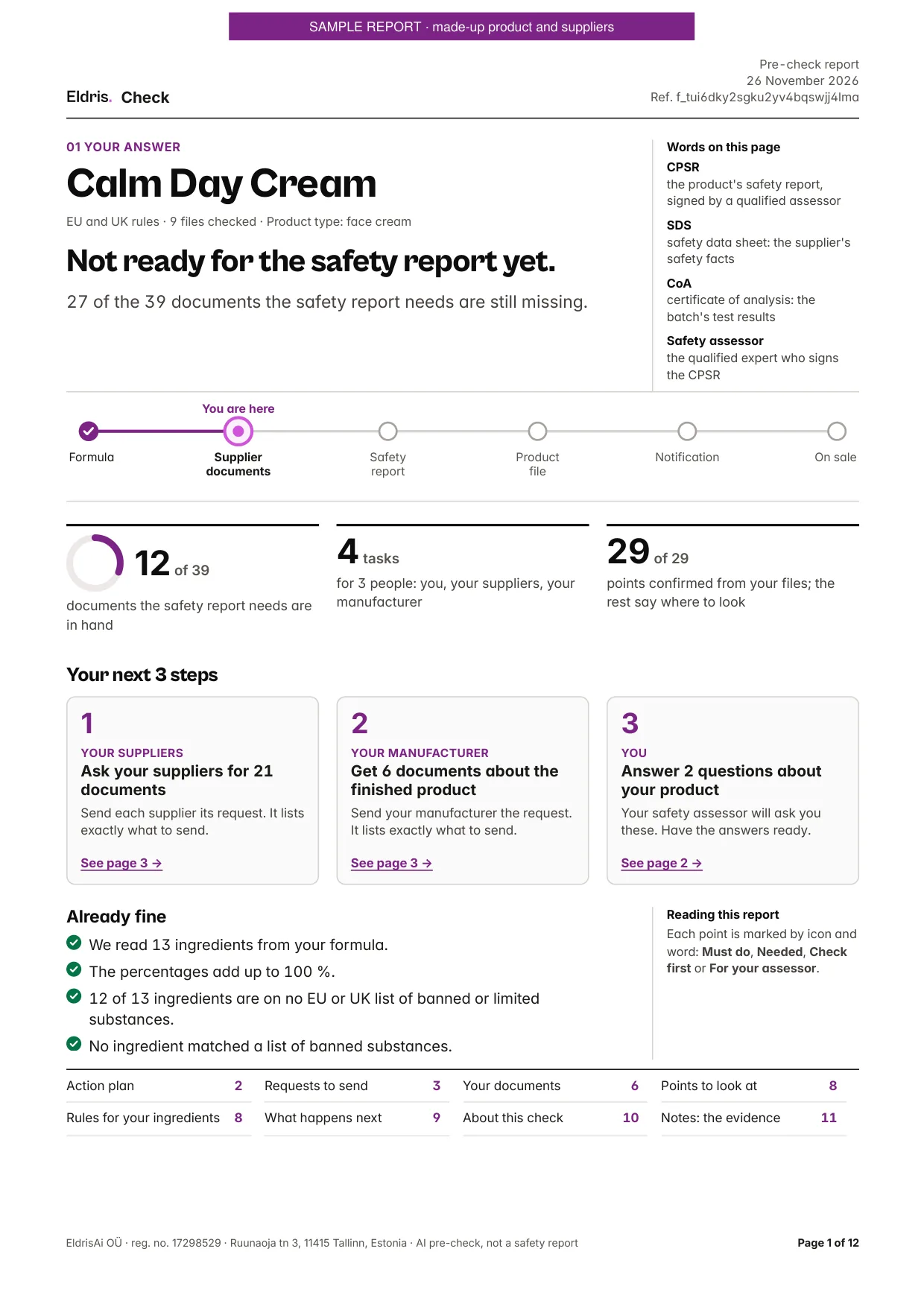
Every Eldris Check report opens with one answer: whether the formula is ready for the safety report, and how many of the documents that report needs are still missing. In the sample, made for a made-up face cream, the answer is that 27 of the 39 documents are still missing.
 Opens the PDF
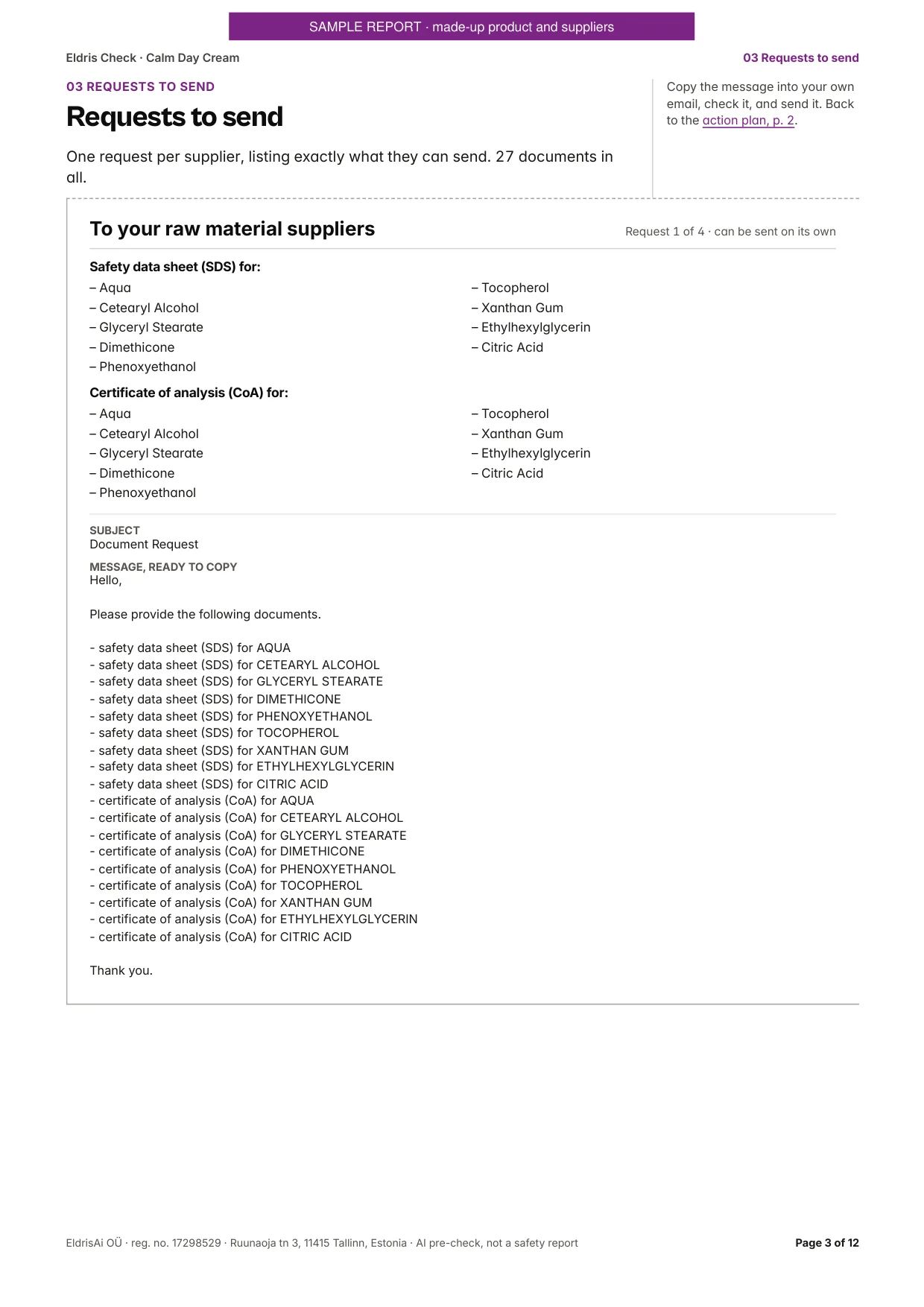
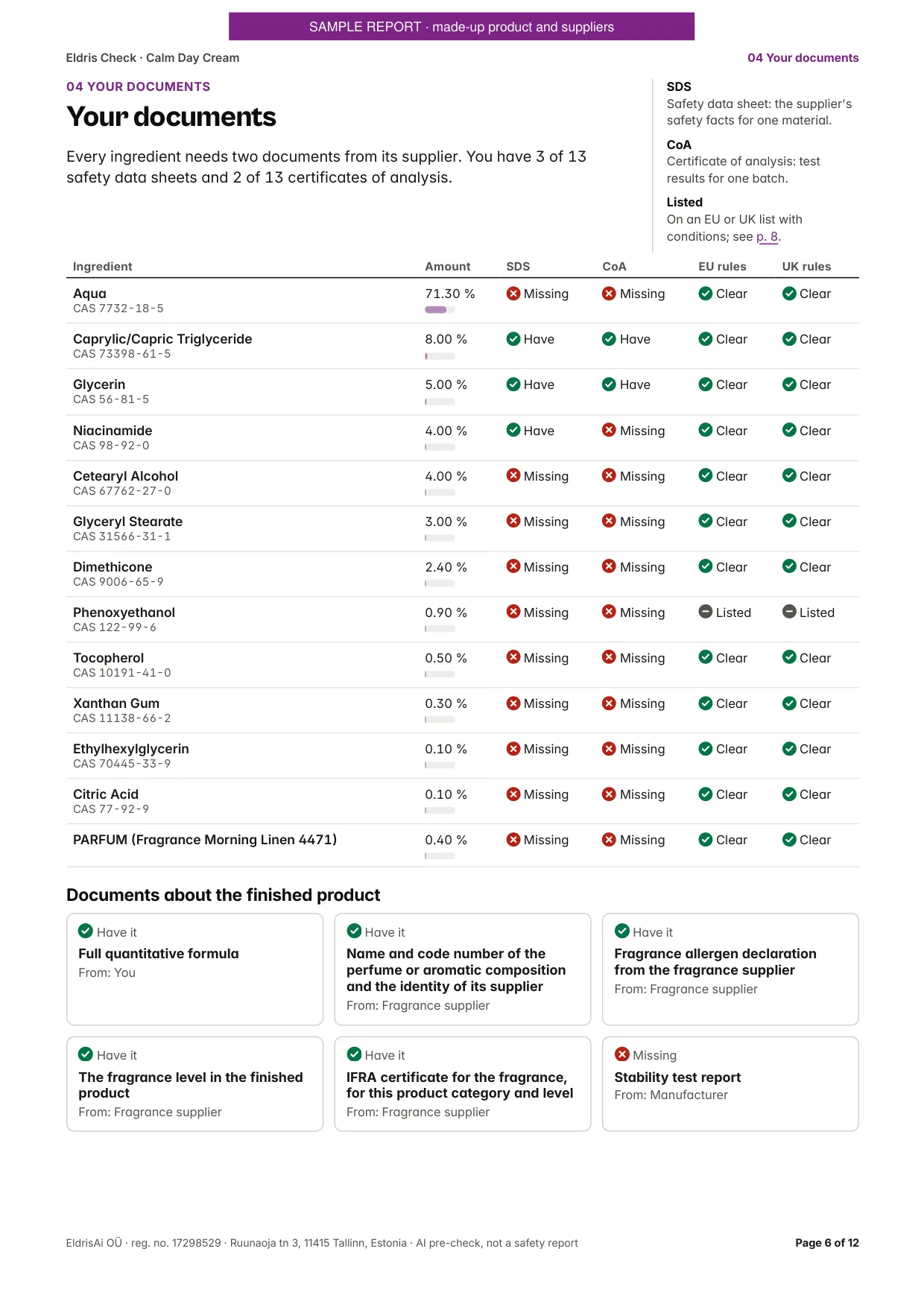
The sample report for Calm Day Cream, a made-up face cream with made-up suppliers, runs to 12 pages. Page 1 gives the answer, a strip that shows where the product stands on the way from formula to sale, and the next three steps: ask the raw material suppliers for 21 documents, get 6 documents about the finished product from the manufacturer, and answer 2 questions the safety assessor will ask. Page 3 holds the requests to send: one per supplier, each listing exactly which safety data sheets (SDS) and certificates of analysis (CoA) to send, with the message ready to copy into your own email. Page 6 lists every ingredient with its amount, whether its SDS and CoA are in hand, and whether it is clear or listed under the EU and Great Britain rules. Below the table come the documents about the finished product, such as the IFRA certificate and the stability test report, each marked as in hand or missing.
Open the sample report (PDF, 12 pages)
Which documents to upload, and what if some are missing
Upload the formula sheet with percentages and INCI names, the safety data sheet (SDS) and certificate of analysis (CoA) for each raw material, the fragrance documents, the test reports and the label artwork. Upload what you have: the report lists each missing document and writes the message to send to the supplier who holds it.
Whether supplier documents are enough is one of the questions sellers ask Eldris most: 43 questions in the Eldris question bank, such as whether a fragrance supplier's IFRA certificate, allergen declaration and safety data sheet will do. Those files cover the fragrance only. In the Eldris Check sample report, every ingredient needs two documents from its supplier, a safety data sheet and a certificate of analysis, and the finished product needs its own, such as the stability test report. Eldris Check sets what you uploaded against the checklist of documents a safety assessor needs and marks each one as in hand or missing. For each missing document, the report says who holds it and gives a message, ready to copy, asking that supplier or the manufacturer for it. Where a file does not show what the assessor needs, the report says what could not be confirmed from the files instead of guessing.
The long answers: the documents a CPSR and PIF need, and whether SDS, IFRA and allergen files are enough for a CPSR.
What to upload for each formula
- Formula sheet with the percentages and INCI names
- Safety data sheet (SDS) and certificate of analysis (CoA) for each raw material
- Fragrance documents: the IFRA certificate and the allergen declaration
- Test reports: stability, preservative challenge, microbiology
- Label artwork
File rules
- PDFs and photos. A PDF over 25 MB is split automatically; a large photo is made smaller automatically.
- Word and Excel files: save them as PDF first.
- Up to 20 formulas per order and 10 variations per formula.
Formula or variation: what the check costs
A formula is one base recipe; a variation is the same base formula in a different scent or shade, and only what differs is checked again. Eldris Check costs £9.95 per formula and £2.95 per variation, paid once per order before the check starts.
How a formula differs from a variation is the largest group of cosmetics questions in the Eldris question bank, 58 questions, often asked as whether each shade of a lipstick range needs its own safety report. In Eldris Check, a range built on one base formula is one formula with its variations inside the same report. A variation keeps the base formula and changes only the scent or the shade, so the check reads the base formula once and checks again only what differs. A different base recipe is a separate formula with its own report. One order can hold up to 20 formulas, and each formula up to 10 variations. The CPSR works in a similar way: a variation usually shares its formula's CPSR rather than needing a separate one written from scratch, and that CPSR must be updated so the safety assessment covers what differs, as the guide on formula and variation for a CPSR explains.
| What | Price |
|---|---|
| Per formulaone base recipe, one report | £9.95 |
| Per variationsame base formula, different scent or shade | £2.95 |
Paid once per order, before the check starts. Charged in pounds (GBP) or euros (EUR); there is no dollar price. In euros: €11.95 per formula and €3.95 per variation.
Start my checkHow the check works and what it does not do
Eldris Check reads your files with AI, looks up each ingredient it can read, by CAS number and by exact name, in Annexes II to VI of Regulation (EC) No 1223/2009 and the Great Britain rules, and writes one report per formula, on screen and as an A4 PDF. It is an AI pre-check of your documents, not a safety assessment and not a signed safety report.
-
Add your formulas and variations
Add each base formula and its variations (the same base formula in a different scent or shade): up to 20 formulas per order and 10 variations per formula.
-
Upload what you have
Upload PDFs and photos for each formula. A PDF over 25 MB is split automatically and a large photo is made smaller automatically; save Word and Excel files as PDF first.
-
Check the order and pay once
Pay once for the whole order, before the check starts: £9.95 per formula and £2.95 per variation (€11.95 and €3.95 in euros).
-
Answer a few optional questions, or skip them
Formulas are checked one after another. A few optional questions may be asked, such as which ingredient a supplier file is for; skipping them still gives a report.
-
Read and download your report
One report per formula, with its variations inside, on screen and as an A4 PDF: the missing documents, what to fix, what could not be confirmed from the files, messages to send to your suppliers, and the checklist of documents a safety assessor needs.
What the check reads, and how
Eldris Check uses AI to read the files you upload: the formula sheet with its INCI names and percentages, the safety data sheets and certificates of analysis from your raw material suppliers, the fragrance documents, the test reports and the label artwork. A value counts as confirmed only when two separate readings agree, the PDF's own text prints it, or a calculation shows it. Each ingredient it can read is looked up by CAS number and by exact name in the EU and Great Britain lists of banned, limited and allowed substances, and the report marks it as clear or as listed with conditions. The files are then set against the checklist of documents a safety assessor needs. During the check, a few optional questions may be asked: one for each supplier file it cannot tie to an ingredient, and a few yes or no questions about the product. Skipping them still gives a report.
What it does not do
- It is not a safety assessment and not a safety report (CPSR). Only a qualified safety assessor can assess the product and sign the CPSR.
- It cannot tell a forged document. The check reads what each document states. It cannot tell a forged document that agrees with itself from the original.
- A name written another way may not be matched. It looks each ingredient up in the EU and Great Britain lists of banned, limited and allowed substances, by CAS number and by exact name.
- It does not review the label and claims in full, or test the product. It does not check rules outside the EU and Great Britain either.
- It does not fill gaps. What the files do not show is listed as could not be confirmed.
- EU and Great Britain rules; the report is in English. The rules checked are the EU rules and the Great Britain rules, and the report is written in English. Northern Ireland is outside the Great Britain rules: the relevant EU rules apply there under the Windsor Framework, and a Responsible Person there must be established in Northern Ireland or the EU.
- No Word or Excel files. Save them as PDF first.
- No fixed time. It depends on how many files and pages each formula has.
Who the check is for
- Brands preparing a first CPSR: the report lists the documents a safety assessor needs and marks which are still missing, before the safety assessment starts.
- Importers with a manufacturer's file: upload the manufacturer's documents as PDFs or photos; the report names the documents about the finished product to get from the manufacturer, with the request ready to send.
- Brands switching provider: upload the documents already held, and the report marks each one as in hand or missing against the same checklist.
How it differs from a safety assessor's review, and from doing nothing
A safety assessor assesses the product and signs the CPSR; Eldris Check does neither. It reads what each document states and lists the missing ones, so they can be collected before the assessment. Doing nothing leaves the same documents needed: under Article 10(1) the safety assessment is made on the basis of the relevant information, and the CPSR is set up in accordance with Annex I.
Sources
- Regulation (EC) No 1223/2009 on cosmetic products (EUR-Lex)
- Regulation (EC) No 1223/2009 as adopted, legislation.gov.uk: Article 4, responsible person; Article 10, safety assessment; Article 11, product information file; Article 13, notification; Article 19, labelling; Article 25, non-compliance by the responsible person
- Cosmetic product notification portal (CPNP), European Commission
- Cosmetic ingredient database (CosIng), European Commission
- Regulation (EC) No 1223/2009 on cosmetic products, legislation.gov.uk
- Making cosmetic products available to consumers in Great Britain, GOV.UK (Northern Ireland: a Responsible Person established in Northern Ireland or the EU)
- Placing CE, or CE and UKNI marked products on the market in Northern Ireland, GOV.UK (under the Windsor Framework, relevant EU rules apply in Northern Ireland)
- Schedule 34, Product Safety and Metrology etc. (Amendment etc.) (EU Exit) Regulations 2019, legislation.gov.uk
- Eldris question bank, 20 October 2026: 453 cosmetics questions from sales email and chat, in 20 groups (the counts on this page). The published answers are on the cosmetics questions page.
- The Eldris Check sample report for the made-up product Calm Day Cream, 12 pages, dated (PDF).
From the check to a signed CPSR and PIF
The step after the check is the safety assessment. In the Eldris CPSR and PIF service, a safety assessor prepares and signs the CPSR from your complete documents and Eldris compiles the PIF; its prices and delivery time are on the Eldris pricing page.
Sellers starting out ask what they need before a lip balm or a serum can be sold in the EU: 44 questions in the Eldris question bank. The Eldris Check sample report shows the path in a fixed order: the formula, the supplier documents, the safety report (CPSR), the product information file (PIF), the notification, and then the product goes on sale. Eldris Check covers the second step, the supplier documents, so you know what to collect before the safety assessment starts. The Eldris CPSR and PIF service covers the next two steps: a safety assessor prepares and signs the CPSR, and Eldris compiles the PIF. The notification is filed by your EU Responsible Person through the CPNP; when Eldris holds that role, Eldris files it, and the fee is shown on the Eldris CPSR and PIF service page.
Read what a CPSR and a PIF contain, or the full cosmetics price list, with volume discounts.
- Formula
- Supplier documents Eldris Check
- Safety report (CPSR) Eldris CPSR and PIF service
- Product file (PIF) Eldris CPSR and PIF service
- Notification your Responsible Person
- On sale
Eldris also provides the Responsible Person (EU & UK) service. Appoint your Responsible Person
Before you upload: what sellers ask.
Answers to 8 questions sellers ask Eldris: open a question to read its answer.
01 Is everything needed included so that I can sell my serum in the EU? +
Not in Eldris Check alone: it is an AI pre-check of your documents, not a signed safety report, and shows which documents the CPSR still needs. Under Regulation (EC) No 1223/2009 the product also needs a Responsible Person in the EU (Article 4), a CPSR signed by a qualified safety assessor (Article 10), a Product Information File (Article 11), a CPNP notification (Article 13) and a compliant label (Article 19).
02 My perfume oil supplier gives me the IFRA, allergen files and MSDS. I don't need anything more, do I? +
Those files cover the fragrance; a safety assessor also needs a safety data sheet and a certificate of analysis for each other raw material, and documents about the finished product such as the stability test report. Upload what you have and the report marks each document as in hand or missing.
03 Can you prepare a CPSR and PIF from SDS only? +
A safety data sheet is one of the documents a CPSR needs, not all of them. Eldris Check lists the others a safety assessor needs, such as the certificates of analysis, the full formula with percentages and the test reports, and shows which ones you already have.
04 What documents are needed? I want a checklist. +
Every Eldris Check report includes a checklist of the documents a safety assessor needs, with the ones already in hand marked.
05 What happens if my manufacturer cannot provide one or more required documents? +
The report names each missing document and who holds it, and gives a ready-to-copy message asking for it. Anything the files do not show is listed as could not be confirmed from the files.
06 Can you check the documentation of specific products before I buy? +
Yes. Eldris Check checks the documents for each formula, with its variations inside one report, before you order the safety report.
07 I have a Drive folder. Can you tell me if anything is missing? +
Upload the PDFs and photos from the folder to Eldris Check, saving any Word or Excel files as PDF first. The report lists each missing document and who holds it.
08 Is a CPSR needed for each shade of a lipstick range? +
Usually not a separate one written from scratch: a new shade of the same formula shares the formula's CPSR, which must be updated so the safety assessment covers what differs, such as a different colourant (the CPSR update for a variation), though a change large enough, such as significantly different ingredients, can need its own CPSR. Eldris Check works the same way: the shades sit inside the formula's report as variations, and only what differs is checked again.
The long answers behind these: the Responsible Person under Article 4, the EU cosmetics labelling rules (Article 19), and formula and variation for a CPSR.
From the Eldris channel
60-second answers
4 short videos from the Eldris YouTube channel, 26 to 52 seconds long, each answering one question sellers ask.
- What Documents Are Required for Cosmetic Compliance Under EU Law?
- Length 0:43What Is a Cosmetic Product Information File (PIF) and Why Is It Needed?
- Length 0:52Do I Need Separate Safety Assessments for Each Perfume Scent or Just One?
- Length 0:26Do Cosmetic Bottles and Boxes Need Different Label Information in the EU?