IFRA Certificate: What It Must Say and How to Read It
An IFRA certificate is a fragrance supplier's own statement that one fragrance mixture conforms to the IFRA Standards, by amendment, product category and level. IFRA does not issue it, and it does not replace a safety assessment. In the EU, Article 10(1) of Regulation (EC) No 1223/2009 requires that assessment before a product is placed on the market.
Prices in this article are in pounds. Your quote is in US dollars.
Prices in this article are in pounds. Your quote is in euros.
What is an IFRA certificate?
It is the Certificate of Conformity to the IFRA Standards. IFRA says it is prepared by the companies that formulate fragrance mixtures, and it confirms conformity for a specified intended use.
The IFRA Standards set the maximum dose of a fragrance ingredient in finished consumer goods. IFRA calls them a voluntary risk management system, mandatory for its own members, and says they do not exempt anyone from national or local rules. The maker of the fragrance mixture need not be a member. IFRA's guidance says anybody familiar with its Code of Practice and Standards can issue the certificate, and that it can be used by non-members. IFRA itself issues no certificates and authorises no third party to issue them on its behalf. The certificate is between the fragrance supplier and its customer. It is generally not issued for a raw material such as a single essential oil, although a supplier may still state that material's conformity. Neither the EU Cosmetics Regulation nor GOV.UK's guidance for Great Britain names the IFRA Standards.
What must an IFRA certificate say?
Its compulsory part names the amendment it covers and, for each product category, the concentration of the fragrance it covers. The rest identifies who issued it, for whom and for which fragrance.
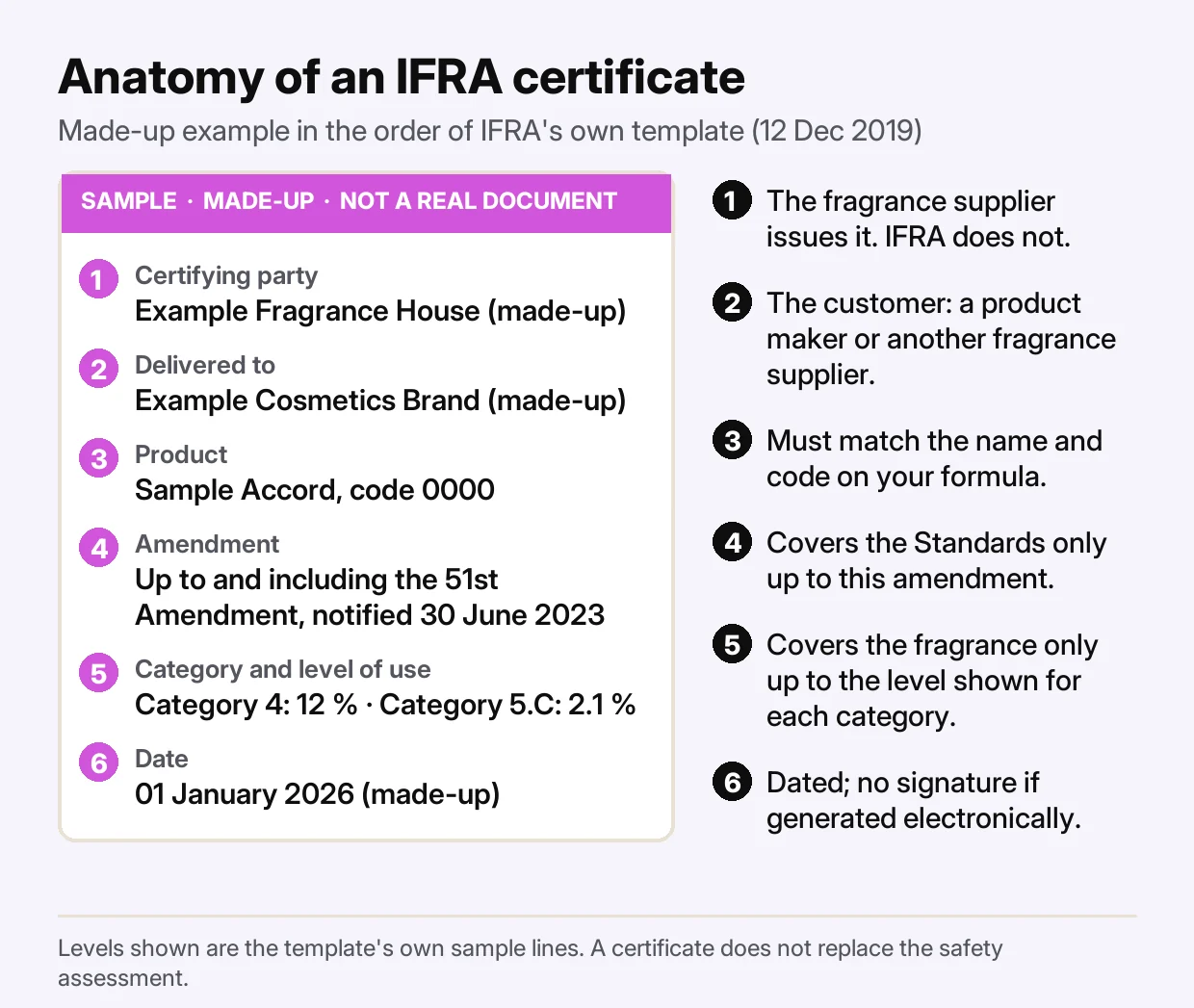
IFRA publishes a template for the certificate, dated 12 December 2019. Its guidance says the number and the notification date of the amendment should be stated. The template is a model, not a mandatory form, and IFRA takes no responsibility for the content or format of a supplier's certificate. The guidance describes the certificate as established by the fragrance mixture manufacturer, on trust between supplier and customer. Suppliers may add, on a voluntary basis, the concentration of each ingredient that an IFRA Standard covers. The fields below follow the template's order, and the amendment, the categories and the levels are its compulsory information. Check the fragrance's name and code against your own formula. In the EU, Annex I of the Regulation asks for the name and code number of a perfume composition and the identity of its supplier.
| Field on the template | What it shows | What to check |
|---|---|---|
| Certifying party | Name and address of the fragrance supplier | The same company that supplies the fragrance |
| Certificate delivered to | The customer: a finished-product manufacturer or another fragrance supplier | Your company, or the manufacturer making your product |
| Scope | Name of the fragrance mixture | The same name and code as on your formula |
| Compulsory information | Amendment covered, with its date; each category with its level of use (%), actual or maximum | Your product's category, and a level at or above your fragrance level |
| Optional information | Ingredients subject to IFRA Standards, with CAS numbers and concentrations | Useful to the safety assessor when given |
| Signature and date | No signature if generated electronically | A date on the certificate |
How do you read the category and the level?
Find your product's IFRA category on the certificate, then compare its level with the fragrance level in your own formula. The certificate covers the fragrance only up to the level it shows for that category.
IFRA's guidance sorts products into numbered categories. Category 4 is fine fragrance products, such as eau de toilette and parfum. Category 5 covers products applied to the face and body using the hands, primarily leave-on. It is split into 5A body lotion, 5B face moisturiser, 5C hand cream and 5D baby products. Categories 7, 10 and 11 have A and B sub-categories as well. The template's sample lines read Category 4 at 12 % and Category 5.C at 2.1 %. One fragrance can therefore carry a different level for each use. The template marks the figure as the actual use level or the maximum use level. Above it, the template says a new evaluation may be needed. Where one product is marketed for several uses, IFRA's guidance says the most stringent restriction applies. A product type that fits no category can be sent to IFRA or RIFM on a categorisation form.
Which amendment should the certificate name?
The certificate confirms conformity with the Standards up to and including the amendment it names. It speaks for nothing published after that amendment.
IFRA's guidance gives 30 June 2023 as the notification date of the 51st Amendment. For the 52nd, IFRA reports that its consultation closed on 12 June 2026. It published the End of Consultation Letter on 1 September 2026. IFRA's pages, read on 26 November 2026, did not say that the 52nd Amendment had been notified. For the latest amendment, IFRA's page sets the dates for fragrance producers by months after notification. A Standard that prohibits an ingredient applies to new creations after 2 months and to existing ones after 13. A Standard that restricts one applies after 9 and 28 months. Read the amendment line together with the certificate's date, because IFRA's guidance asks for both. After those dates, IFRA says its member fragrance houses may no longer ship fragrance mixtures that do not comply.
IFRA certificate, allergen declaration or SDS: which does what?
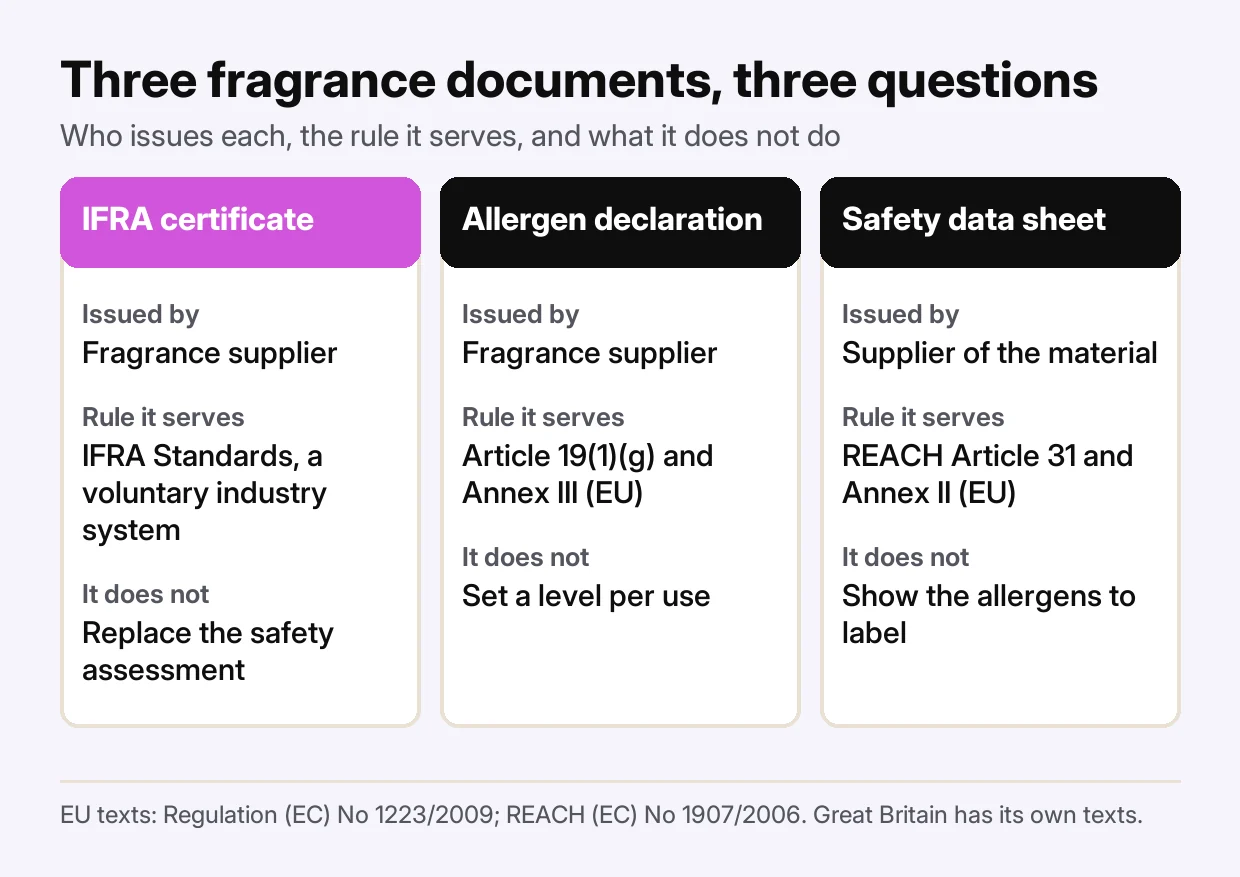
Each answers a different question. The certificate gives the fragrance's level per use. The allergen declaration gives the allergens in the fragrance and their levels, and the safety data sheet gives hazards and handling.
In the EU, Article 19(1)(g) lists a fragrance as parfum or aroma, plus the substances that Annex III's Other column requires. For each allergen, Annex III sets the trigger at 0,001 % in a leave-on and 0,01 % in a rinse-off product. Those are levels in the finished product, so a figure in the declaration is multiplied by the fragrance level in the formula to compare. Commission Regulation (EU) 2023/1545 extended the list beyond the 24 allergens labelled before it. The EU deadline for placing products that do not meet it on the market was 31 July 2026. Products already placed may be made available until 31 July 2028. The Great Britain text of Annex III, read on 26 November 2026, does not list the allergens it added, such as vanillin. A safety data sheet follows REACH Article 31, with 16 headings from identification to other information.
| Document | Who issues it | Rule it serves | What it does not do |
|---|---|---|---|
| IFRA certificate | The fragrance supplier | IFRA Standards, a voluntary industry system | Replace the safety assessment |
| Allergen declaration | The fragrance supplier | Article 19(1)(g) and Annex III (EU) | Set a level per use |
| Safety data sheet | The supplier of the material | REACH Article 31 and Annex II (EU) | Show the allergens to label |
Frequently asked questions
Can I get an IFRA certificate from IFRA itself?
No: IFRA does not create certificates and authorises no third party to issue them on its behalf. The supplier that makes the fragrance mixture issues the certificate for it.
Is an IFRA certificate required by EU law?
The EU Regulation does not name it; it asks for the perfume composition's name, code number and supplier, and for allergen labelling under Annex III. Eldris asks for the certificate with any fragrance as part of its own start list.
Is there a certificate for a single essential oil?
Generally not, because IFRA says certificates are generally not issued for raw materials. Where an essential oil is used as such in a product, IFRA's guidance asks its supplier to keep constituents with a Standard within the product limit.
My fragrance goes into a body lotion and a perfume. Which level applies?
Each product uses its own category's level: Category 5A for a body lotion and Category 4 for a perfume. Where one product is marketed for several uses, the most stringent restriction applies.
Which IFRA amendment is the current one?
IFRA notified the 51st Amendment on 30 June 2023. Its consultation on the 52nd closed on 12 June 2026, and its pages did not show the 52nd as notified on 26 November 2026.
Sources
The documents this guide relies on, each linked where the source is published online.
- IFRA Standards and the Certificate of Conformity, International Fragrance Association
- IFRA Standards documentation (51st Amendment guidance, certificate template)
- Regulation (EC) No 1223/2009, Article 19 and Annexes I and III, EUR-Lex
- Commission Regulation (EU) 2023/1545, EUR-Lex
From the Eldris channel
60-second answers
10 short videos from the Eldris YouTube channel, 26 to 50 seconds long, each answering one question sellers ask.
- Length 0:44Who Qualifies to Perform a Hair Clay Cosmetic Safety Assessment?
- Length 0:29Must Perfume Batch Numbers Appear on the Container or Packaging?
- Length 0:26Do Cosmetic Bottles and Boxes Need Different Label Information in the EU?
- Length 0:36Who Must Be the Responsible Person for Cosmetics Under EU Law?
- Length 0:31Could a Rabbit Skin-Irritation Test for Algerian Rules Affect a Favourable CPSR or EU Placing?
- Length 0:40When Do I Need Extra Evidence for My Soap’s Safety Assessment?
- Length 0:49What Documents Are Required for Cosmetic Compliance Under EU Law?
- Length 0:32What Must a Responsible Person Do Before Selling Cosmetics in the UK?
- Length 0:50Can You Use Alpaca Wool in Soap Under EU Cosmetics Law?
- Length 0:43What Is a Cosmetic Product Information File (PIF) and Why Is It Needed?
Cosmetics compliance by Eldris
CPSR and PIF from £195 per formula, 5–10 working days
Eldris prepares the Cosmetic Product Safety Report (CPSR) and the Product Information File (PIF) for each formula. A variation of an assessed formula (new shade or scent) is £39.95. When Eldris is your EU Responsible Person, Eldris also files the CPNP notification for £99 per CPSR.
Get your CPSR and PIFAlso needed before you sell
EU & UK Responsible Person
The legal representative that sellers based outside the EU must name on their products before selling there, under Regulation (EC) No 1223/2009 for cosmetics (and the General Product Safety Regulation, GPSR, for other products). The UK has its own product rules; Eldris covers the UK as an additional market. Certificate and label address issued in under a minute.
from £195 one-off, then from £19.95 a month
Appoint your Responsible PersonDomain