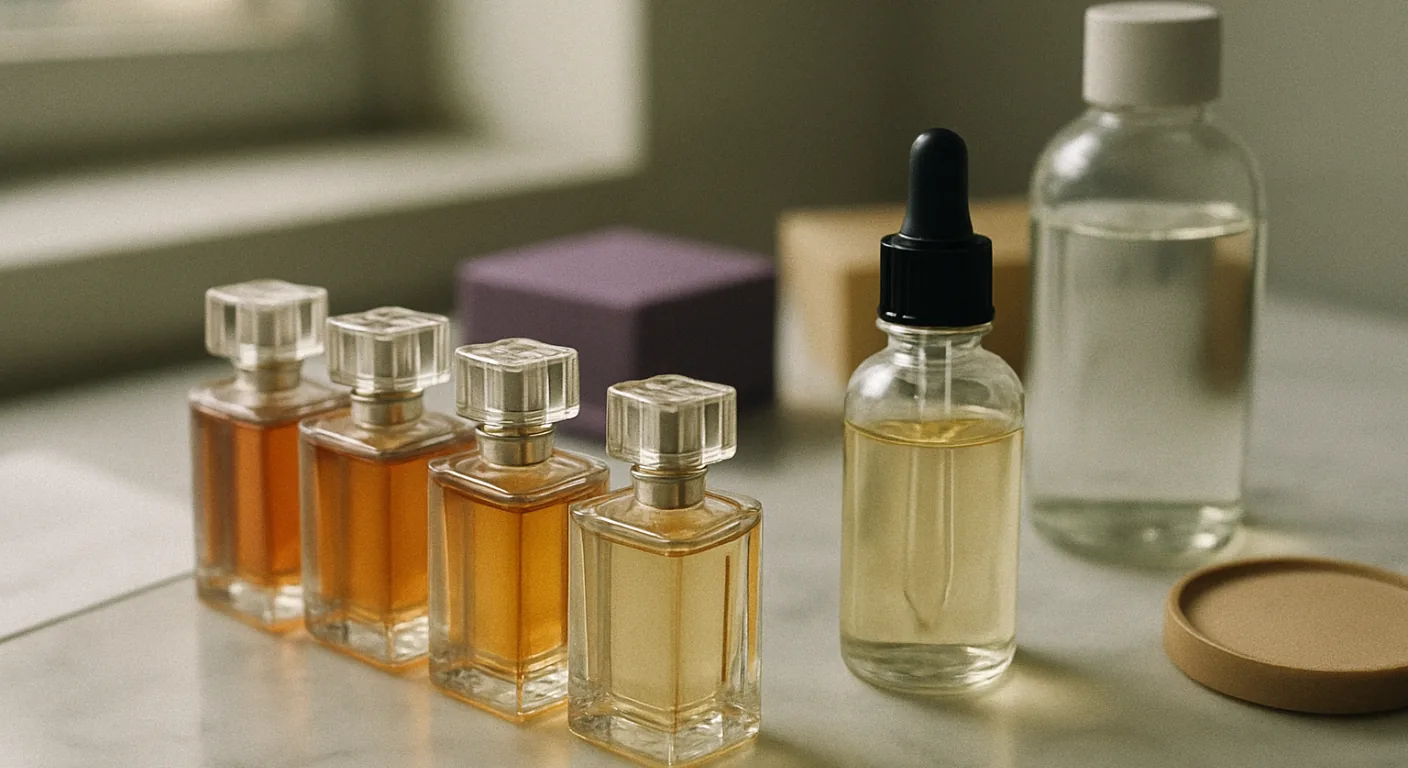
Selling Perfume in the EU: Documents a Perfume Maker Needs
This question was put to Eldris 14 times by 13 sellers between and .
A perfume made by mixing oil with ethanol is a fragrance product, a cosmetic type Eldris assesses. Selling perfume in the EU needs a safety report before the product is placed on the market under Regulation (EC) No 1223/2009 (Article 10(1)). To start, Eldris needs the formula, a safety data sheet for every raw material and certificates of analysis, plus the IFRA certificate, the allergen declaration and the fragrance level.
Regulation (EU) 2023/1545 adds fragrance allergens to be declared on labels. Eldris's CPSR and notification service delivers the CPSR and PIF 5–10 working days after it receives your complete documents. The formula and variation guide explains the count, and the pricing page shows the per-formula fee and the variation fee.
CPSR and PIF price
Get your price by email
Is a perfume made from oil and ethanol a cosmetic?
A perfume made from oil and ethanol is a fragrance product, and fragrance products are a cosmetic type Eldris assesses.
The Regulation's definition of a cosmetic names perfuming among its main purposes and covers a substance or mixture for the external parts of the body (Article 2(1)(a)). Fragrance products include eau de parfum, EDT, body mist and solid perfume. The finished mixture of oil and ethanol is the product Eldris assesses.
The usual cosmetic steps then apply: a Responsible Person designated within the EU (Article 4(1)), a safety report set up under Annex I (Article 10(1)), a Product Information File (Article 11) and a notification before the product is placed on the market (Article 13(1)). Your EU Responsible Person notifies the product through the Cosmetic Product Notification Portal. Eldris files the EU notification only when it is your EU Responsible Person and you order the filing. Eldris prepares the CPSR and PIF, but the Responsible Person and laboratory tests are not included.
Does each scent need its own safety assessment?
Not always. A formula is one unique base recipe, and each further scent is a variation sharing the formula's CPSR. A new scent can need its own CPSR if the fragrance ingredients change significantly.
Every item you list counts as a product, including each scent, while a formula is one unique base recipe. In a perfume, a new scent means new fragrance ingredients, so the question is how far they change. A product that needs its own CPSR is priced as a formula instead of a variation, and Eldris discusses that with you first. A product in several sizes counts once.
The formula and variation guide explains the count, and the pricing page shows the per-formula fee and the variation fee. Several formulas earn a volume discount on the formula fee: 5% from 4 formulas, 10% from 7 and 15% from 10. Variations neither earn nor receive it. A reformulated scent is a different case: a reformulated product needs an updated notification and a new CPSR, priced as a formula.
Which documents does a perfume need to start?
To start a product, Eldris needs the formula, a safety data sheet for every raw material and certificates of analysis.
With fragrance, it also needs the IFRA certificate, the allergen declaration and the fragrance level, which describes your finished product. The perfume oil and the ethanol are each a raw material, so each needs its own safety data sheet. Product photos are not needed.
The formula can be uploaded or typed in as an ingredient list, and the per-formula fee stays the same whatever the number of ingredients. You pay first, then upload what you have in your Eldris portal, and Eldris tells you what is still missing. Eldris's CPSR and notification service delivers the CPSR and PIF 5–10 working days after it receives your complete documents. If the safety assessor needs more from you, the question appears in your portal, and the 5–10 working days start again from the day you answer. The clock restarts; it never pauses. At Eldris, a qualified safety assessor signs the CPSR, Part A and Part B, and the documents arrive in your portal.
What about the ethanol, and does Eldris ask for a challenge test?
No ethanol-specific rule is stated here. Eldris asks for a challenge test report (ISO 11930) for products that contain water, not water-free ones, but you can start your order without it.
That is a statement of Eldris's service, not a provision of Regulation (EC) No 1223/2009. Whether Eldris asks depends on whether the finished perfume contains water, so look at the finished perfume, not at the oil alone. If it contains water, Eldris asks for a challenge test report; if it is water-free, Eldris does not ask for one. The ethanol is a raw material like the oil, so its supplier's safety data sheet goes in with the others.
Eldris is not a testing laboratory and names no laboratory. It does not carry out, arrange or recommend laboratory tests. Stability, challenge, SPF and microbiology tests are done by a testing laboratory, which sets the price, and laboratory tests are not in the per-formula fee. The test reports you supply go into the PIF. This guide covers the cosmetic safety documents only. It states no rule on alcohol content, denaturing, duty, transport or hazard labelling for ethanol.
What must the label show when selling perfume in the EU?
Regulation (EU) 2023/1545 adds fragrance allergens to be declared on labels, and Article 19 sets the other label items.
As a rule, these include the Responsible Person's name and address, the nominal content, and a batch number or a reference identifying the product, on both the container and the packaging (Article 19(1)). The date of minimum durability or, where the rule allows, the period after opening is also listed. Article 19 has exceptions for small products, so read each point in full.
With Eldris as your EU Responsible Person, your label carries EldrisAi OÜ, Ruunaoja tn 3, 11415 Tallinn, Estonia, while your monthly plan runs. The ingredients list may be given on the packaging alone (Article 19(1)(g)). Where the ingredients cannot practically be labelled on the pack, they go on an enclosed leaflet, label, tape, tag or card referred to on the pack (Article 19(2)). The formula fee includes an Article 19 label review, which follows the CPSR result. The FAQ page gives the short answer on what a perfume maker needs to sell in the EU.
Frequently asked questions
Does Eldris need an IFRA certificate for my perfume?
With fragrance, Eldris needs the IFRA certificate, the allergen declaration and the fragrance level. It also needs the formula, a safety data sheet for every raw material and certificates of analysis. After you pay, upload what you have in your Eldris portal and Eldris tells you what is still missing.
I only mix two ingredients. Does the Regulation still apply?
The Regulation's definition of a cosmetic covers a substance or mixture for the external parts of the body (Article 2(1)(a)). Before a cosmetic is placed on the EU market, the Responsible Person must ensure a safety assessment and a CPSR (Article 10(1)). Eldris assesses the finished mix of oil and ethanol as a fragrance product.
Do I need a Responsible Person to sell perfume?
Yes. Only a cosmetic with a Responsible Person designated within the EU may be placed on the EU market (Article 4(1)). A business established in the EU can hold the role itself, and a seller based outside the EU needs an EU Responsible Person. Eldris offers the role as a separate service.
What changes if I reformulate a scent?
A reformulated product needs an updated notification and a new CPSR, priced as a formula. A new pack size of the same formula adds nothing to the CPSR and PIF. A new scent that changes the fragrance ingredients significantly can need its own CPSR.
Does Great Britain need separate steps for perfume?
Great Britain has its own rules, including a Responsible Person established in the UK. Eldris can be your UK Responsible Person as a separate appointment, and in that role it files the UK notification for the same per-CPSR fee as the EU notification. Whether a CPSR made for the EU is accepted in Great Britain is not stated here.
Is anything monthly?
The cosmetics fees are paid once, with no monthly fee for this service. Only the Responsible Person service runs on a monthly plan. You can cancel it at any time, effective at the end of the billing period. The appointment then ends, and Eldris's details must come off your labels and listings within 30 days.
Is the EU notification included in the formula fee?
No. The notification is a separate line, charged per formula, not per country, with the same volume discount as the formula fee. Eldris files the EU notification only when it is your EU Responsible Person and you order the filing, and only then is it in your quote total. Otherwise your EU Responsible Person files it.
Sources
- Regulation (EC) No 1223/2009 on cosmetic products (EUR-Lex)
- Cosmetic Products Notification Portal (CPNP), European Commission
- Commission Regulation (EU) 2023/1545 on the labelling of fragrance allergens (EUR-Lex)
From the Eldris channel
60-second answers
 Length 0:44Who Qualifies to Perform a Hair Clay Cosmetic Safety Assessment?
 Length 0:29Must Perfume Batch Numbers Appear on the Container or Packaging?
 Length 0:26Do Cosmetic Bottles and Boxes Need Different Label Information in the EU?
 Length 0:36Who Must Be the Responsible Person for Cosmetics Under EU Law?
 Length 0:31Could a Rabbit Skin-Irritation Test for Algerian Rules Affect a Favourable CPSR or EU Placing?
 Length 0:40When Do I Need Extra Evidence for My Soap’s Safety Assessment?
 Length 0:49What Documents Are Required for Cosmetic Compliance Under EU Law?
 Length 0:32What Must a Responsible Person Do Before Selling Cosmetics in the UK?
 Length 0:50Can You Use Alpaca Wool in Soap Under EU Cosmetics Law?
 Length 0:43What Is a Cosmetic Product Information File (PIF) and Why Is It Needed?
Cosmetics compliance by Eldris
CPSR and PIF from £195 per formula, 5–10 working days
Eldris prepares the Cosmetic Product Safety Report (CPSR) and the Product Information File (PIF) for each formula. A variation of an assessed formula (new shade or scent) is £39.95. When Eldris is your EU Responsible Person, Eldris also files the CPNP notification for £99 per CPSR.
Get your CPSR and PIFAlso needed before you sell
EU & UK Responsible Person
The legal representative that sellers based outside the EU must name on their products before selling there, under Regulation (EC) No 1223/2009 for cosmetics (and the General Product Safety Regulation, GPSR, for other products). The UK has its own product rules; Eldris covers the UK as an additional market. Certificate and label address issued in under 60 minutes.
£195 per market, one-off, then from £19.95 a month
Appoint your Responsible PersonDomain