EU Cosmetics Labelling Requirements: What Must Appear on Your Packaging
EU cosmetics labelling requirements govern exactly what must appear on your product packaging before it can be sold in the European Union. Your product label is the most visible expression of your compliance. It is also one of the areas where Amazon sellers most frequently get it wrong. A product can have a perfect CPSR, a complete PIF, and a valid CPNP notification — but if the label does not meet the requirements of Article 19 of EU Cosmetics Regulation 1223/2009, it is non-compliant.
Labelling issues are particularly problematic because they are visible. Amazon listing images show your packaging. Market surveillance authorities can spot non-compliant labels simply by purchasing a product. And once you have printed thousands of labels, fixing errors means reprinting — adding cost and delay.
This guide covers every mandatory element that must appear on your cosmetics packaging for the EU market.
CPSR and PIF price
Get your price by email
EU Responsible Person Name and Address
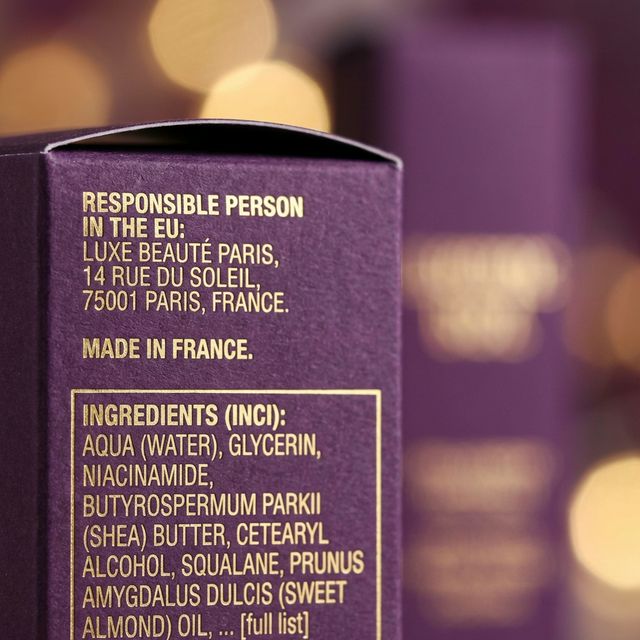
The name and address of the EU Responsible Person must appear on the product packaging. This is the legal entity established within the EU who is responsible for the product's compliance under the regulation. Their name and a postal address within the EU must be clearly printed on the outer packaging (the box or carton) and, where practicable, on the container (the bottle, tube, or jar) itself.
For sellers based outside the EU — UK, US, or elsewhere — this means your own company name and address alone is not sufficient. You need an EU-based entity on the label. If you appoint an EU Responsible Person through Eldris, their details are provided specifically for this purpose.
The EU Responsible Person details on the label must exactly match the details submitted in the CPNP notification. Any discrepancy — even a different address format — can cause issues during compliance checks.
Country of Origin
If the cosmetic product is manufactured outside the EU, the country of origin must be stated on the packaging. For UK-manufactured products being sold in the EU post-Brexit, this means "Made in UK" or "Made in United Kingdom" must appear on the label. This requirement did not exist when the UK was an EU member state, so sellers working from older label designs may need to update them.
Nominal Content
The packaging must state the nominal content at the time of packaging — the weight or volume of the product. This is expressed in grams or millilitres (or kilograms/litres for larger products). For products below 5g or 5ml, or for single-use sachets and free samples, this requirement does not apply. For sets or multipacks, the total number of items must be indicated if this cannot be seen from outside the packaging.
Date of Minimum Durability or Period After Opening
Products with a minimum durability (shelf life) of 30 months or less must display a "best before" date, preceded by the hourglass symbol or the words "best before." The date format is month and year, or day, month, and year.
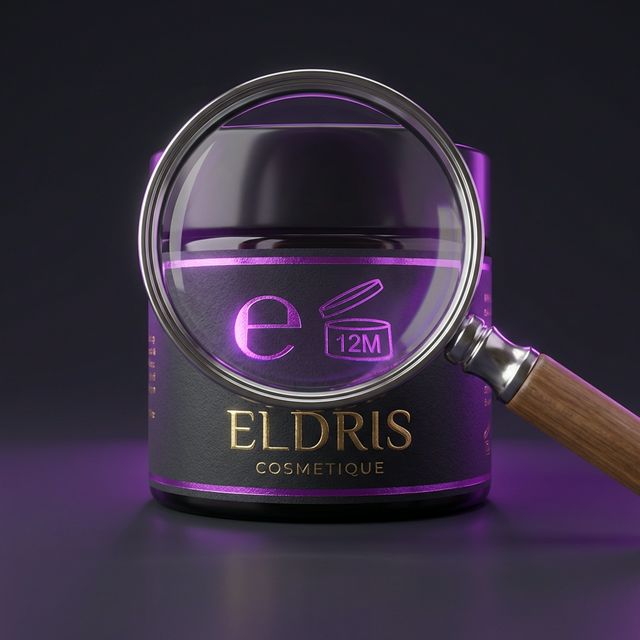
Products with a minimum durability of more than 30 months must instead display the Period After Opening (PAO) symbol — the open jar icon with a number inside indicating how many months the product remains safe to use after first opening. For example, "12M" inside the open jar symbol means the product should be used within 12 months of opening.
Most cosmetics fall into the PAO category. The PAO period is determined during product development based on stability and preservative efficacy data. The safety assessor references this in the CPSR, so the PAO on your label should be consistent with the data in your safety assessment.
PAO is not required for products where the concept of opening is not meaningful — single-use products, products that are not opened (aerosols), and products where the manufacturer demonstrates that the formula is not at risk from microbial degradation after opening.
Precautions for Use
Any particular precautions that must be observed during use must appear on the label. These are not optional marketing warnings — they are specific precautions mandated by the regulation for certain product types and ingredients. Annex III of Regulation 1223/2009 lists restricted substances along with their conditions of use and mandatory label warnings.
For example, products containing hydrogen peroxide above certain concentrations must carry specific warnings. Hair dye products must include patch test warnings. Products containing certain UV filters must state specific usage conditions. The safety assessor will identify any mandatory precautions during the CPSR process.
Batch Number
Every product must display a batch number or reference that allows identification of the specific production batch. This is essential for traceability — if a safety issue is identified, the batch number allows targeted recall rather than pulling all stock.
The batch number can appear on the outer packaging, the container, or both. It is often preceded by the word "Lot" or the letter "L" though this is not strictly required. The format is at the manufacturer's discretion — alphanumeric codes, date-based codes, or sequential numbers are all acceptable.
Product Function
The function of the product must be stated on the packaging unless it is obvious from its presentation. A product labelled "hand cream" has an obvious function. A product with a brand name like "Midnight Velvet" does not — in this case, the function (moisturiser, cleanser, serum, and so on) must be stated explicitly.
INCI Ingredient List
The ingredient list is one of the most regulated elements of cosmetics labelling. All ingredients must be listed using INCI nomenclature — the standardised naming system maintained in the CosIng database by the European Commission.
The list must be preceded by the word "Ingredients" (this is used universally across all EU languages). Ingredients must be listed in descending order of concentration for ingredients present at 1% or more. Ingredients present at less than 1% may be listed in any order after the 1%+ ingredients. Colourants may be listed in any order after all other ingredients, using their CI (Colour Index) numbers.
Allergens listed in Annex III — the 26 allergenic substances that must be individually declared — appear at the end of the ingredient list when present above the threshold concentrations of 0.001% in leave-on products and 0.01% in rinse-off products. These must be listed by their INCI names (for example, Linalool, Limonene, Citronellol), not by generic terms like "fragrance allergens."
Getting the INCI list right requires accurate knowledge of every ingredient in the formulation at its correct INCI name — see the full EU cosmetics documentation guide for sourcing requirements, plus the allergen breakdown from the IFRA certificate for any fragrance compounds. Eldris provides a formatted INCI list as part of the compliance documentation package, derived directly from the formula data used in the CPSR.
Language Requirements
Mandatory label information must be in the official language or languages of the EU member states where the product is sold. In practice, this means that a product sold across multiple EU markets needs multilingual labelling. The INCI ingredient list is exempt from this requirement because INCI names are already internationally standardised.
For Amazon sellers, this typically means that the product function, precautions for use, and any other mandatory text must appear in the language of each target market — German for Amazon.de, French for Amazon.fr, Italian for Amazon.it, and so on. Many sellers address this with multilingual labels covering their primary markets, or with peel-back labels that provide multiple language versions.
The Hand and Book Symbol
If space on the container is too small to include all mandatory information, certain elements — specifically precautions for use and the ingredient list — may be printed on an enclosed leaflet, label, tape, or tag instead. When this is done, the container must display the "hand and book" symbol (a hand pointing to an open book) to indicate that further information is enclosed.
The EU Responsible Person details, the nominal content, the durability marking, and the batch number must always appear on the container itself and cannot be moved to enclosed information.
Symbols Used in EU Cosmetics Labelling
EU cosmetics labelling uses several standardised symbols. The open jar symbol (PAO) indicates the period after opening. The hourglass symbol indicates a best-before date. The hand and book symbol indicates that information is provided on an enclosed leaflet. The letter "e" indicates that the nominal content complies with the EU average system for pre-packed products.
These symbols are recognised across all EU member states without translation, which makes them particularly useful for multilingual packaging.
Getting Your Label Right First Time
Label reprints are expensive and time-consuming. Getting the label right before printing is significantly cheaper than fixing it afterwards — especially if you have already shipped inventory to Amazon FBA warehouses.
Eldris includes packaging compliance guidance with every CPSR and PIF (£195 per formula). This covers a detailed review of your label artwork against all Article 19 requirements, specific feedback on missing or incorrect elements, the formatted INCI list for direct use in your artwork, allergen declarations based on your IFRA data, and guidance on PAO marking based on your stability and challenge test data.
For a full overview of the compliance documentation that feeds into your labelling, see the documents required guide.
Sources
- Regulation (EC) No 1223/2009 on cosmetic products (EUR-Lex)
- Cosmetic Products Notification Portal (CPNP), European Commission
- Commission Regulation (EU) 2023/1545 on the labelling of fragrance allergens (EUR-Lex)
- CosIng, the cosmetic ingredient database, European Commission
Cosmetics compliance by Eldris
CPSR and PIF from £195 per formula, 5–10 working days
Eldris prepares the Cosmetic Product Safety Report (CPSR) and the Product Information File (PIF) for each formula. A variation of an assessed formula (new shade, scent or size) is £39.95. When Eldris is your EU Responsible Person, Eldris also files the CPNP notification for £99 per CPSR.
Get your CPSR and PIFAlso needed before you sell
EU & UK Responsible Person
The legal representative that sellers based outside the EU must name on their products before selling there, under Regulation (EC) No 1223/2009 for cosmetics (and the General Product Safety Regulation, GPSR, for other products). The UK has its own product rules; Eldris covers the UK as an additional market. Certificate and label address issued the same day.
£195 per market, one-off, then from £19.95 a month
Appoint your Responsible Person