Eldris data
Where the beauty sellers on Amazon's EU marketplaces are based, 2026
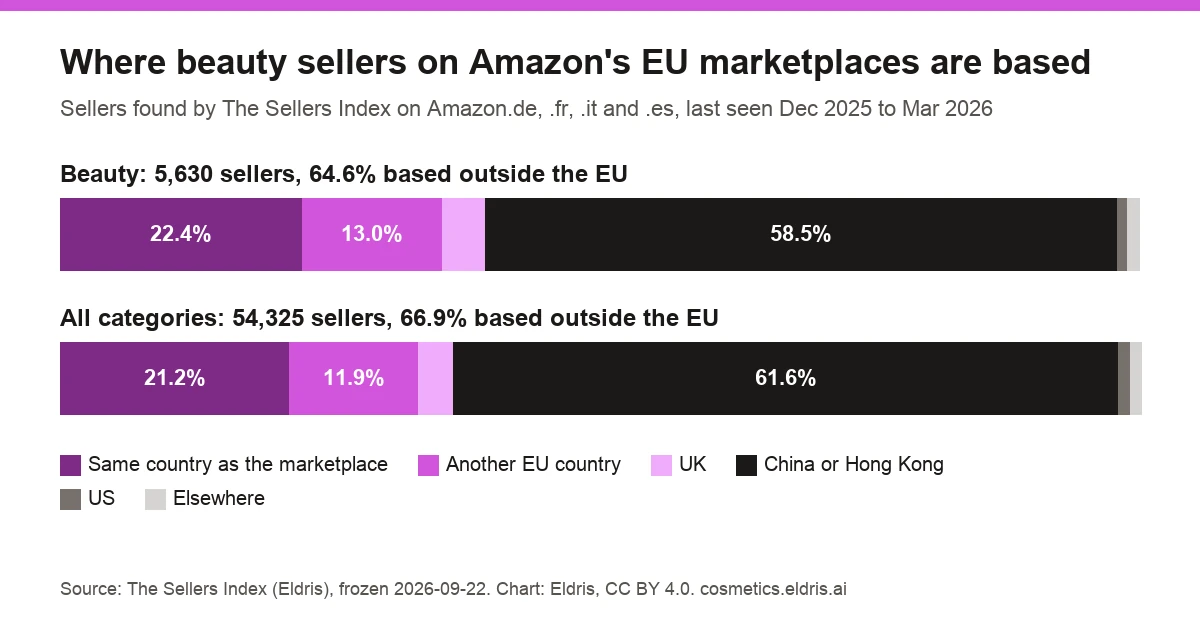
Of the 5,630 sellers in Amazon's beauty category that The Sellers Index found on Amazon.de, Amazon.fr, Amazon.it and Amazon.es, 64.6% had a business address outside the EU and 58.5% were based in China or Hong Kong. Only 22.4% were based in the country of the marketplace they sell on. On Amazon.co.uk, 44.4% of 808 beauty sellers were based outside the UK.
Selling cosmetics in the EU? Eldris prepares the CPSR and PIF for £195 per formula. Get your CPSR and PIF
The sellers were last seen between December 2025 and March 2026. The figures say where sellers are based. They say nothing about whether any seller complies.
CPSR and PIF price
Get your price by email
64.6%
of the 5,630 beauty sellers on Amazon DE, FR, IT and ES are based outside the EU
58.5%
of those sellers are based in China or Hong Kong
22.4%
of those sellers are based in the marketplace's own country
44.4%
of the 808 beauty sellers on Amazon.co.uk are based outside the UK
Beauty sellers: where they are based
Share of the sellers found in Amazon's beauty category, by the country of their business address, with all categories on the same marketplaces for comparison.
| Group | Sellers | Same country | Other EU | UK | China or Hong Kong | US | Elsewhere | Outside the EU |
|---|---|---|---|---|---|---|---|---|
| Beauty | 5,630 | 22.4% | 13.0% | 4.0% | 58.5% | 0.9% | 1.1% | 64.6% |
| All categories | 54,325 | 21.2% | 11.9% | 3.2% | 61.6% | 1.1% | 1.0% | 66.9% |
| Group | Sellers | UK | EU | China or Hong Kong | US | Elsewhere | Outside the UK |
|---|---|---|---|---|---|---|---|
| Beauty | 808 | 55.6% | 10.9% | 8.5% | 11.0% | 14.0% | 44.4% |
| All categories | 4,104 | 69.1% | 10.2% | 8.2% | 7.2% | 5.4% | 30.9% |
By marketplace, all categories
The frozen figures split sellers by marketplace for all categories together, not for beauty alone, so this table covers every category.
| Marketplace | Sellers | Same country | Other EU | UK | China or Hong Kong | US | Elsewhere | Outside the EU |
|---|---|---|---|---|---|---|---|---|
| Amazon.de | 20,806 | 24.6% | 9.0% | 2.5% | 62.0% | 0.9% | 1.0% | 66.4% |
| Amazon.fr | 4,982 | 21.0% | 20.1% | 4.7% | 51.2% | 1.3% | 1.5% | 58.8% |
| Amazon.it | 13,047 | 22.1% | 14.9% | 3.8% | 57.4% | 0.9% | 0.9% | 63.0% |
| Amazon.es | 15,490 | 15.7% | 10.7% | 3.3% | 68.0% | 1.4% | 0.8% | 73.6% |
| All four | 54,325 | 21.2% | 11.9% | 3.2% | 61.6% | 1.1% | 1.0% | 66.9% |
Countries outside the EU with the most sellers
All categories on the four EU marketplaces, by the country of the business address.
| Country | Sellers | Share of the four marketplaces |
|---|---|---|
| China | 32,387 | 59.6% |
| United Kingdom | 1,759 | 3.2% |
| Hong Kong | 1,087 | 2.0% |
| United States | 603 | 1.1% |
| Switzerland | 100 | 0.2% |
| India | 95 | 0.2% |
| Taiwan | 53 | 0.1% |
| Türkiye | 46 | 0.1% |
What Eldris's own cosmetics records show
Counted on 26 September 2026 from Eldris's order and quote records, test entries left out.
- 43 cosmetics orders were opened with Eldris between 29 March 2026 and 22 September 2026. 16 of them (37%) have a recorded payment.
- 142 products were recorded against those orders from 13 April 2026, and 24 have had their finished documents released to the customer.
- 82 quotes were issued between 8 June 2026 and 23 September 2026: 47 in pounds, averaging £861, and 35 in euros, averaging €767. The full quote table is on the CPSR cost page.
Counts under 10 are not published, so the answers to the Responsible Person question and any split by country are left out.
Quick answers
Where are the beauty sellers on Amazon's EU marketplaces based?
In The Sellers Index data, 64.6% of the 5,630 beauty sellers found on Amazon.de, Amazon.fr, Amazon.it and Amazon.es had a business address outside the EU and 58.5% were based in China or Hong Kong. 22.4% were based in the country of the marketplace they were found on.
What share of Amazon.co.uk beauty sellers are based outside the UK?
44.4% of the 808 beauty sellers with a recorded country found on Amazon.co.uk.
Does a cosmetics seller based outside the EU need someone in the EU?
Yes. A cosmetic may be placed on the EU market only if a legal or natural person within the EU is designated as its Responsible Person (Regulation (EC) No 1223/2009, Article 4(1)).
Where does this data come from?
From The Sellers Index, Eldris's own record of Amazon third-party sellers, frozen on 22 September 2026. Only totals are published; no seller is named, and counts under 10 are withheld.
How the figures were made
- Source. The Sellers Index, Eldris's own record of Amazon third-party sellers. The whole table held 82,450 sellers. The tables here cover the 58,429 that carry one of these five marketplaces and a recorded country, last seen between 4 December 2025 and 18 March 2026. Eldris counted them on 22 September 2026. The same frozen figures are published, with a CSV, on consult.eldris.ai.
- Marketplace. The Amazon marketplace on which The Sellers Index found the seller (one per seller).
- Based in. The country of the business address recorded for the seller. Sellers with no recorded country (241 across the five marketplaces) are left out.
- Beauty. The Amazon category The Sellers Index files the seller under: Beauty, Beauty & Personal Care, Belleza or Bellezza.
- Privacy. Only totals are published. Counts under 10 are withheld. No seller is named or can be identified.
Limits
- This is the sample The Sellers Index collected, not a census of Amazon. Read the shares as "of the sellers found", not "of all sellers on Amazon".
- The marketplaces were collected in different windows: Amazon.de December 2025 to February 2026; Amazon.fr January 2026 to March 2026; Amazon.it January 2026 to March 2026; Amazon.es February 2026 to March 2026; Amazon.co.uk December 2025 to February 2026.
- The category is the one each seller is filed under. A seller filed under beauty may sell other products, and a seller of cosmetics may be filed under another category.
- Two Eldris samples disagree. In the smaller set of 16,931 sellers enriched with contact details, 14.3% of its 9,578 entries on the four EU marketplaces (a seller found on two marketplaces counts twice) are based outside the EU. The reason is the website: in the main table, sellers with a website are 19.6% based outside the EU (15,253 sellers) and those without are 85.4% (39,072); the enriched set is, in effect, the sellers with a website.
- This page replaces the ten Eldris data pages of 1 June 2026, which drew on an earlier, smaller sample. Their addresses now lead here.
- Where a seller is based says nothing about whether it complies. This page makes no claim that any seller does or does not.
Licensed CC BY 4.0: credit "Eldris (cosmetics.eldris.ai)" and "The Sellers Index".
Sources
- The Sellers Index: Eldris's own record of Amazon third-party sellers, frozen 22 September 2026 (the figures as CSV, on consult.eldris.ai)
- Eldris's cosmetics order and quote records, counted 26 September 2026
- Regulation (EC) No 1223/2009 on cosmetic products (EUR-Lex)
- Cosmetic Products Notification Portal (CPNP), European Commission
- Making cosmetic products available to consumers in Great Britain, GOV.UK
- Schedule 34, Product Safety and Metrology etc. (Amendment etc.) (EU Exit) Regulations 2019, legislation.gov.uk